The Fire & the Veil · Foundation of Asha
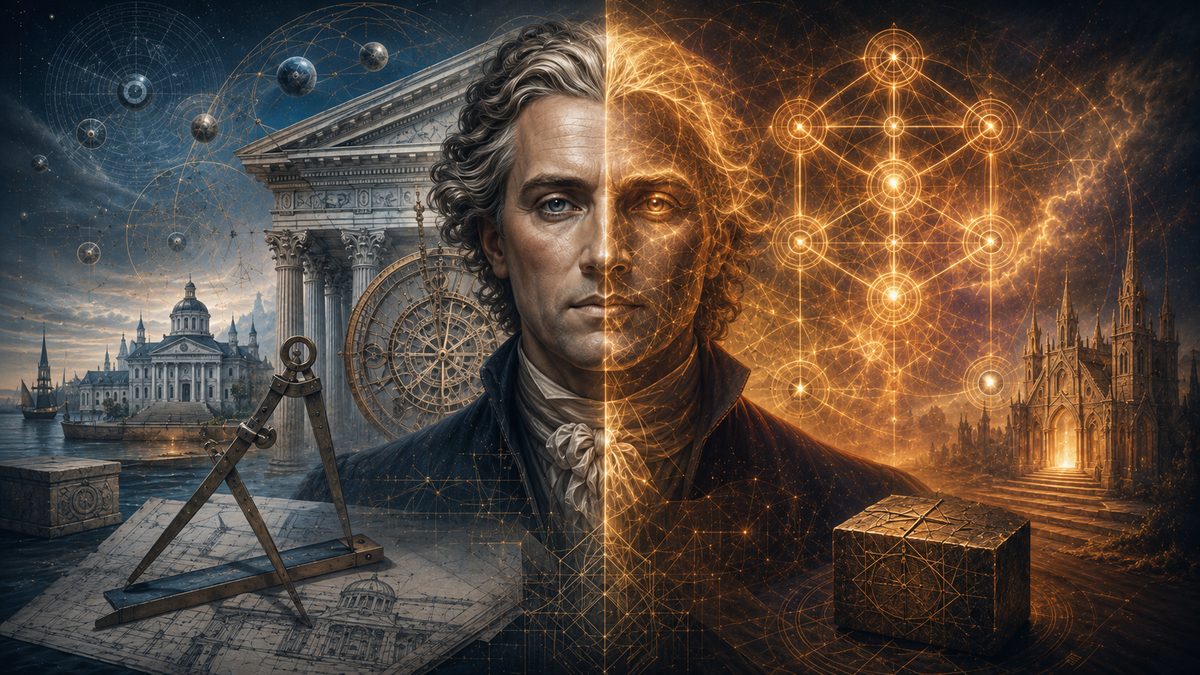
The Architect's Two Faces
On Deism, the hidden Kabbalah of the West, and the discipline of tracing connections without losing your mind
This essay grew out of a long conversation that began with a small, half-remembered question about the Pledge of Allegiance and wandered somewhere neither party expected. It is offered less as a set of conclusions than as the record of an excavation, and of a method learned in the digging.
¶ I. The small question
It started with a hunch about the founders. The intuition ran roughly like this: the men who built the United States were children of the Enlightenment who believed in a "natural" God, a cosmic clockmaker knowable through reason rather than revelation, and somewhere down the line a religious faction smuggled God back into the nation's civic liturgy, planting under God in the Pledge of Allegiance where it had not been before.
The hunch was half right, which is the most dangerous kind. The Pledge really was altered, and under God really was a later insertion. But the faction was misremembered. It was not the Jesuits; it was the Knights of Columbus, a Catholic lay fraternity, and the year was not some shadowy founding-era plot but 1954, at the height of the Cold War. And the founders themselves were not the uniform deists of legend.
Pull on those two small corrections and a trapdoor opens. What looks like a tidy question about a schoolchildren's pledge turns out to rest on a buried history of how the modern West actually assembled its tangled relationship to God, to reason, and to hidden knowledge. The excavation yields something more durable than any single fact: a method for telling a real lineage from a mirage. That method, in the end, is the true subject of what follows.
¶ II. The exoteric story: Nature's God and the wall
Begin where the popular story begins, with the clockmaker.
Deism is best understood as the theology the Scientific Revolution made nearly unavoidable for educated people. Before Newton, the cosmos was an enchanted hierarchy of angelic movers and final causes, a universe God sustained from moment to moment. After the Principia, it became clockwork, a handful of mathematical laws governing planets, tides, and falling apples as one autonomous machine. That single shift did two things at once. It made an intervening God look superfluous, since a perfect engineer does not keep reaching in to repair his own mechanism, and it made a designing God look obvious, since a clock of that elegance implies a clockmaker. Deism is simply the resolution of the tension: keep the clockmaker, drop the meddling.
Underneath the physics lay a deeper move. Locke and the empiricists made reason, rather than authority, the judge of truth, and once reason sits as judge, everything that fails its bar (the Trinity, the miracles, original sin) is liable to be struck out, leaving a minimal "natural religion" of one God, virtue, and an afterlife, derivable by anyone anywhere without a single prophet. There was a visceral motive as well as an intellectual one: the century before had been a Christian bloodbath of religious wars, and a stripped-down, universal creed promised a way out of the killing. Nature's God, the deity of Jefferson's Declaration, is precisely the God a republic needs: not the revealed, hierarchical sovereign who anoints kings, but a rational deity accessible to all, fit to ground a government justified by natural law rather than divine right.
So far the popular story holds. Then it fails, twice.
It fails first because the founders were not uniform deists but a spectrum. The historian Gregg Frazer's term theistic rationalism fits most of the leading figures better than deism does: they believed in an active, prayer-answering providence and revered Jesus as a moral teacher, yet rejected his divinity, the Trinity, and the full inspiration and infallibility of the Bible. Jefferson took a razor to the Gospels and cut out every miracle, producing a "Bible" that ends with Jesus laid in the tomb and no resurrection. Franklin, weeks before his death, wrote that Jesus's morals were the best the world had seen but confessed "some doubts as to his divinity," and, far from a doctrinaire rationalist, he stood up at the Constitutional Convention and proposed they open with prayer. Washington was a private and reticent Anglican. The label flattens a far more various reality.
It fails a second and more important time because the nation never lived by Deism at all. Deism was a drawing-room philosophy of a thin, literate elite, and it had no churches, no clergy, no popular base. Within a single generation of the founding, the Great Awakenings flooded the country with the exact opposite of cool rational religion: emotional, democratic, revivalist Protestantism. The Second Great Awakening made Methodists and Baptists, not deists, the mass faith of the new republic. The deist founders were not a trend line but a high-water mark that the country's own religious energy flowed around almost immediately.
A cluster of cherished myths can be cleared away here in passing, because they all turn out to be inflations of a real but smaller truth. The founders were overwhelmingly not Freemasons: by the Masons' own records, only about nine of the fifty-six signers of the Declaration belonged to a lodge (the exact count is genuinely disputed, since lodge records are inconsistent), far from the legendary "most" or "all," and the most consequential founders (Jefferson, Adams, Madison, Paine) were not members. The Eye of Providence on the dollar bill is not Masonic in origin; it is a conventional Christian emblem of divine watchfulness, adopted for the Great Seal in 1782 by men who were not Masons, and it did not reach the currency until 1935, placed there under Franklin Roosevelt. The Bavarian Illuminati were a real but tiny society, founded in 1776 and crushed by the Bavarian state within a decade, with no documented thread to any modern cabal. And under God was bolted onto the Pledge in 1954, driven by the Catholic Knights of Columbus and a Presbyterian minister's sermon and signed by Eisenhower, while In God We Trust became the national motto only in 1956. The God-soaked surface of American civic life is largely a mid-twentieth-century Cold War invention, not a founding inheritance. People project the piety of the 1950s backward onto the 1780s and assume it was always there.
But the real prize of this first descent is not a debunking. It is a correction of what there is to admire. The thing worth loving in the American founding is not "Reason defeating Religion." It is disestablishment, the wall between church and state, and the striking fact is that the wall was built by an unlikely coalition. The fiercest separationists were not the deists but the evangelical Baptists, men like Roger Williams, Isaac Backus, and John Leland, precisely because they were the ones being taxed to fund an established church and jailed for preaching without its license. Leland allied directly with Madison to secure the First Amendment's protections, and Jefferson's famous image of "a wall of separation between Church and State" comes from a letter he wrote to a Baptist association worried about its liberty. Liberty of conscience, it turns out, was never a tribe you could sneer from inside of. It was a coalition, deist and Baptist, gentleman and circuit-rider, agreeing on a single rule: that none of them should get to turn the government into a weapon against the others. That is a sturdier and more beautiful thing than the binary the popular story sells, and it is the first lesson the excavation teaches. The distinctions matter. The moment you melt the camps together, you lose the very thing worth seeing.
¶ III. The esoteric story: the smuggler's tunnel
Beneath the exoteric story runs a deeper current, and finding it requires correcting an error, one I made myself, early, and which is worth confessing because the confession is the method in miniature.
The tempting move is to draw Deism as a branch of Protestantism, a sibling of the evangelical revival, both growing off the trunk of the Reformation. That is wrong, and the wrongness is instructive. The evangelical line genuinely is a Protestant descendant; it runs from Pietism through Methodism to the Awakenings without ever leaving Christianity. But Deism is not a species of Protestant Christianity. It throws out the very things that make Protestantism Protestant: scriptural revelation, Christ's divinity, salvation by faith. It is not a reform of Christianity but an exit from it. The Reformation was its enabling condition, since it shattered Rome's monopoly and licensed private judgment, which is what let rational religion be spoken aloud without a stake and kindling, but a condition is not a parent. To call Deism a Protestant branch is to confuse the soil with the seed.
And once you stop forcing Deism into the Protestant slot, its real ancestry comes into view, and it is plural. There is classical antiquity, with Cicero's religion of nature and Stoic providence, natural religion predating Christ by centuries. There is the Scientific Revolution, pan-confessional, its clockwork built by a heterodox Newton and a Catholic Descartes alike. There is the rationalist philosophical line running through Descartes and, above all, through Spinoza, an excommunicated Sephardic Jew, no Protestant at all. And there is a fourth root that never makes the Enlightenment recruitment poster, the one that turns this whole inquiry on its axis: the Hermetic-Kabbalistic esoteric tradition.
Here the buried river finally surfaces, and it can be traced with real precision.
The Zohar, the foundational text of theosophical Kabbalah, presents itself as the second-century teaching of a Galilean sage, Rabbi Shimon bar Yochai. It is not. The scholarly consensus, established by Gershom Scholem, holds that it was written in late-thirteenth-century Castile, around the 1280s, by Moses de León, its artificial Aramaic and medieval references betraying its true age. From there its passage into Christian Europe is documented through identifiable texts and named men. Giovanni Pico della Mirandola, in 1486, folded Kabbalah into his vision of a universal ancient wisdom; Johannes Reuchlin systematized "Christian Kabbalah" in De Arte Cabalistica in 1517. This fused with the freshly translated Corpus Hermeticum, with Neoplatonism, and with alchemy into a single Renaissance occult philosophy. And the decisive conduit arrived in 1677, when Christian Knorr von Rosenroth published the Kabbala Denudata, a vast Latin rendering of large portions of the Zohar and of Lurianic Kabbalah, the channel through which non-Hebrew-reading Europe read the Zohar for the next two centuries.
That stream poured directly into speculative Freemasonry, whose central myth is the building of Solomon's Temple (sacred architecture, sacred geometry, the divine Name, the two pillars), a mythology soaked in Kabbalistic resonance, with the higher degrees openly absorbing Hermetic and Rosicrucian material. And it surfaced again, vividly, in the nineteenth-century occult revival: Éliphas Lévi placed the Kabbalah at the center of Western magic, and the Hermetic Order of the Golden Dawn built the comprehensive system of correspondences on the Sefirotic Tree of Life that remains standard, its founder, MacGregor Mathers, having translated part of Knorr's seventeenth-century Latin into the English Kabbalah Unveiled. A continuous textual thread runs from a thirteenth-century book of Castilian mysticism to the diagrams of modern occultism.
The payoff of this descent is an image. The Great Architect of the Universe, that emblem of the rational Enlightenment and of the Masonic lodge, turns out to have two faces. One is the Newtonian clockmaker, cold reason, the engineer of a law-governed cosmos. The other is the Kabbalistic-Hermetic Divine Architect: Ein Sof, the infinite, structuring creation through emanation, number, and sacred geometry, the God who builds through the Sefirot. The Masonic Architect stands precisely at the seam where the clockmaker and the emanator overlap. And the founders' own intellectual heroes embody the doubling. Newton built the clockwork and then spent decades on alchemy and on reconstructing the sacred geometry of Solomon's Temple, which he believed encoded a lost divine wisdom; Keynes, cataloguing his secret papers, called him "the last of the magicians," not the first of the scientists. Spinoza handed the Enlightenment Deus sive Natura, God identical with an immanent Nature, no distant clockmaker at all but something that rhymes structurally with the Kabbalistic immanent divine, even as Spinoza himself sneered at "Kabbalistic triflers."
What this exposes is a third stream that fits neither bucket of the popular story. It is neither the Deist clockmaker nor the dogmatic church; it is esoteric, immanentist, and experiential: Kabbalah, Hermeticism, Gnosticism, alchemy, and, in the twentieth century, Carl Jung, who psychologized the entire apparatus. In his hands Ein Sof became the collective unconscious, the Sefirot became archetypes, the Sitra Achra became the Shadow, the Shekhinah the Anima, and tikkun, the repair of a broken cosmos, became individuation, the integration of a broken self. This stream rejects the clockmaker, because its God is alive and within rather than absent, and it equally rejects external dogma, because its truth is inner gnosis rather than the Church's command. Its "I do not believe, I know" is the mystic's experiential certainty, not the deist's syllogism nor the believer's faith. And it is braided, invisibly, into the rational Enlightenment that the official histories celebrate. The Freemasonry of the founders was not only the clockmaker's lodge. It was also the smuggler's tunnel through which the Zohar entered the modern West. The "Age of Reason" branding quietly painted over its own Kabbalistic plumbing.
¶ IV. The discipline: a lineage is not a mirage
And here the inquiry arrives at its real reward, which is not a fact but a method, because the moment you discover a buried river, you are seized by the temptation to see it everywhere, and the same faculty that found the genuine connection is exactly the faculty that manufactures false ones.
Everything turns on a single distinction: transmission versus resemblance. Transmission is a documented channel: real texts, real translators, datable influence, traceable citation. Zohar to Knorr to the Golden Dawn is transmission; you can trace it, date it, and falsify it. Resemblance is merely the noticing that two things share a shape. The whole discipline of intellectual history consists in refusing to let the second masquerade as the first.
Resemblance is cheap, and it is worth being precise about why. The deep narrative motifs (dead matter awakened by spirit, a dark figure who imprisons innocence, a test of selflessness, a broken kingdom restored) are not distinctively Kabbalistic. They are the basic grammar of story. Jung's own archetypes, Joseph Campbell's monomyth, and Vladimir Propp's morphology of the folktale are theories of precisely why these patterns recur across unrelated cultures without any common descent. This is why one can "find the Zohar" in a children's film or a chocolate factory, not because they descend from it, but because the Zohar and they alike draw from the same deep human well. The Sitra Achra "explains" a children's-film villain exactly as well as it explains Sauron and the wolf in Red Riding Hood, which is to say it does not explain him at all. It merely renames him.
From this falls the inversion that matters most. The very universality that lets you find a pattern everywhere is the proof that finding it is not evidence of descent. The Zohar is a profound book precisely because it maps universal structures of the psyche, which is the literal reason Jung was drawn to it, and that universality cuts both ways. A map that fits everything cannot be used to claim any particular territory. The instant a framework "explains" a musical and quantum mechanics and the founding of a republic, it has stopped discriminating and become a horoscope. It feels like X-ray vision; it is a Rorschach blot.
Falsifiability, in this domain, has a simple and humbling face: a framework worth anything must be able to say not this one. The cleanest test case the inquiry produced was a man often misremembered as an occult initiate but who is in fact the perfect negative control: Thomas Jefferson, who razored the mystery out of the Gospels, who despised "enthusiasm," who was not a Mason and bore not a molecule of Kabbalah. He sits at the dry Ciceronian end of the spectrum, the anti-mystic. And that is the point. Newton the alchemist is inside the esoteric stream; Jefferson the razor is outside it. Spinoza's immanent God is in; the rationalist creed of an English deist is out. If your net catches Newton and Jefferson and a chocolate factory, it is not a net. It is the ocean, and you have stopped fishing.
The false unifying narrative reaches its most dangerous form when it leaves literature for history. "All of history is one continuous hidden war between a persecuted people and their eternal enemy" is among the most seductive story-shapes there is, and it is seductive because it is emotionally complete and pattern-perfect, which is precisely why it is nearly always false. Consider the temptation to read two millennia as "Rome versus the Jews." It collapses three completely different actors who happen to share a name: the ancient Empire that burned the Second Temple in 70 CE, the medieval Papacy, and Mussolini's fascist state of 1929. They share a syllable, not an agenda. And the Holocaust detonates the frame outright, because it was perpetrated by Nazi Germany, not by Rome: Hitler was neither Roman nor acting for Rome, and Mussolini's Italy was in fact a laggard at persecuting its Jews until the German occupation of 1943. The word "Rome" linking 70 CE and 1943 performs exactly the trick "Sitra Achra" performs linking Sauron and a film villain: a shared label faking a shared substance. The antidote is the unglamorous discipline that the whole inquiry keeps circling back to, making the distinct things stay distinct. Seventy CE and 1943 are not the same event with a costume change.
The same hazard wears a gentler mask in the study of mysticism. The resemblance between Kabbalah and Vedanta is real at the level of structure: an infinite ground, a world of appearance, a logic of emanation and return. But the differences are decisive. Kabbalah is theistic, ethical, covenantal, and drenched in history; its tikkun, the repair of a broken God's vessels through human action, has no real analogue in Advaita Vedanta, whose impersonal Brahman and whose goal of release from maya point in another direction entirely. The live scholarly debate here, the perennialists who posit a common mystical core against the constructivists (following Steven Katz) who argue that mystical experience is always shaped by its tradition, turns on exactly this question. "All the mystics secretly teach the same thing" is the overreach. "The esoteric cores of different traditions rhyme, while their exoteric forms differ" is the defensible and genuinely interesting claim. The line between them is the line this whole essay is about.
There is, finally, a hazard peculiar to the present moment, and intellectual honesty requires naming it, because it shaped this very inquiry. The instrument is rigged. Ask any large language model, including the ones that helped assemble these notes, to connect two arbitrary things, and it will, fluently, complete with a confident-sounding score, because manufacturing plausible connections is the one thing the architecture cannot refuse to do. Feed it the Zohar and a parking ticket and you will get four numbered parallels and an offer to go deeper. A machine reliably finding the Zohar everywhere is therefore not four independent confirmations. It is the same machine returning its default output regardless of input. That is not a witness. It is an echo. The pattern-finder's oldest temptation now has an inexhaustible, tireless, eloquent enabler, and the discipline required to resist it has never mattered more.
¶ V. The shape of the real
So what did the excavation actually find, when the digging was done and the mirages cleared?
Not one story but several, partially overlapping, genuinely distinct. A legally secular founding, which has held remarkably constant. A popular evangelical religion that flooded in within a generation and never receded. A civic religiosity bolted onto the state's symbols in the Cold War. A rationalist Enlightenment with classical and scientific roots. And beneath all of it, a real esoteric tributary, documented text by text, carrying the Zohar into the modern West and into the lodges and the depth psychology that followed. A handful of true documented contacts; a great many merely structural resemblances. The truth is less unified than the myth, and far more interesting. The myth offers a single key that opens every door. The reality offers a building of distinct rooms, a few joined by real corridors, most merely decorated in similar styles. The myth flatters the pattern-finder. The reality rewards the disciplined one.
The deepest lesson is about two faculties that a serious mind must hold together and never confuse. One finds connections; the other tests them. The first, left alone, slides into apophenia: the Zohar in everything, history as one eternal war, every notable figure a secret initiate. The second, left alone, is a sterile pedantry that never notices the buried river in the first place. Neither is sufficient. The whole art lies in the dialectic between them: propose boldly, test ruthlessly, and keep only what survives the testing. The connection is worth something exactly insofar as some things refuse to fit it.
The Architect, then, really does have two faces: the clockmaker and the emanator, reason and mystery, the documented and the merely resembling. The work is not to choose one face and deny the other, nor to smear them into a single blur in which everything is secretly everything else. The work is to hold both in view at once, and to know, at every step of the digging, which of the two you are looking at.
¶ Common questions
¶ What is the difference between transmission and resemblance?
Transmission is a documented channel: real texts, real translators, datable influence, traceable citation, the kind of link you can trace, date, and falsify. The Zohar reaching the Golden Dawn through Knorr von Rosenroth's Latin is transmission. Resemblance is merely the noticing that two things share a shape. The whole discipline of intellectual history is refusing to let the second masquerade as the first.
¶ Were the American founders deists?
Not uniformly; "deism" flattens a spectrum. Gregg Frazer's term theistic rationalism fits most of the leading figures better: they believed in an active, prayer-answering providence and revered Jesus as a moral teacher while rejecting his divinity and the Trinity. And the nation never lived by Deism at all. Within a generation the Great Awakenings made revivalist Methodists and Baptists, not deists, the mass faith of the republic.
¶ When was "under God" added to the Pledge of Allegiance?
In 1954, at the height of the Cold War, driven by the Catholic Knights of Columbus and a Presbyterian minister's sermon, and signed by Eisenhower. "In God We Trust" became the national motto in 1956. The God-soaked surface of American civic life is largely a mid-twentieth-century invention, not a founding inheritance.
¶ Did Kabbalah really influence Western occultism and Freemasonry?
Yes, and this one is genuine transmission, not mere resemblance. The Zohar (written in 1280s Castile) passed into Christian Europe through Pico della Mirandola and Reuchlin, then through Knorr von Rosenroth's Latin Kabbala Denudata (1677), into speculative Freemasonry's Temple-building mythology and the nineteenth-century occult revival (Éliphas Lévi, the Golden Dawn). A continuous, documented textual thread runs from a thirteenth-century book to the diagrams of modern occultism.
Every factual claim in this essay is sourced. The full claim-by-claim receipts, each fact rated for how firmly the record supports it, are gathered in the sources and strength-of-evidence companion. Where the documented record is strong, where the scholarship is genuinely contested, and where the popular version is simply wrong, both the essay and that companion say so. The discipline they describe, transmission versus resemblance, is the same one the method holds to everywhere.
→ Read the book: The Fire and the Veil (free, with a DOI: https://doi.org/10.5281/zenodo.20619291). · One recovered thing a week: the Substack.
Sources: G. Frazer, The Religious Beliefs of America's Founders (2012); G. Scholem, Major Trends in Jewish Mysticism (1941); J. M. Keynes, "Newton, the Man" (1947); B. Spinoza, Theological-Political Treatise (1670); S. Katz, Mysticism and Philosophical Analysis (1978); USHMM Holocaust Encyclopedia. CC BY 4.0.
Get one recovered thing a week.
Sourced religious history, tier-honest, never fabricated. Start with the free book, The Fire and the Veil (PDF, DOI-archived).
Free. One email a week. Unsubscribe anytime. No spam, no fabrication.There is a world you can walk into.
Athena’s Palace is a living world — an agora where positions are argued and settled, a plaza you share with whoever else is awake, and dozens of games besides. Free in your browser, no account needed.
Enter Athena’s PalaceOr go straight there: athenaspalace.comDiscuss this with people who read it too.
Foundation of Asha keeps a Discord for readers working through the Map of Consciousness, the Zohar, the Gospels and the Avesta — five years of archived discussion, and a room that answers.
Join the DiscordPermanent invite: discord.gg/npZ6kBzPj5Reader-funded. No ads, no paywall, no fabrication.