The Fire & the Veil · Foundation of Asha
The Devil Was Assembled
Four words became one place. An office became a name. Neither happened by accident, and both are checkable.
Start with the word everyone thinks they know.
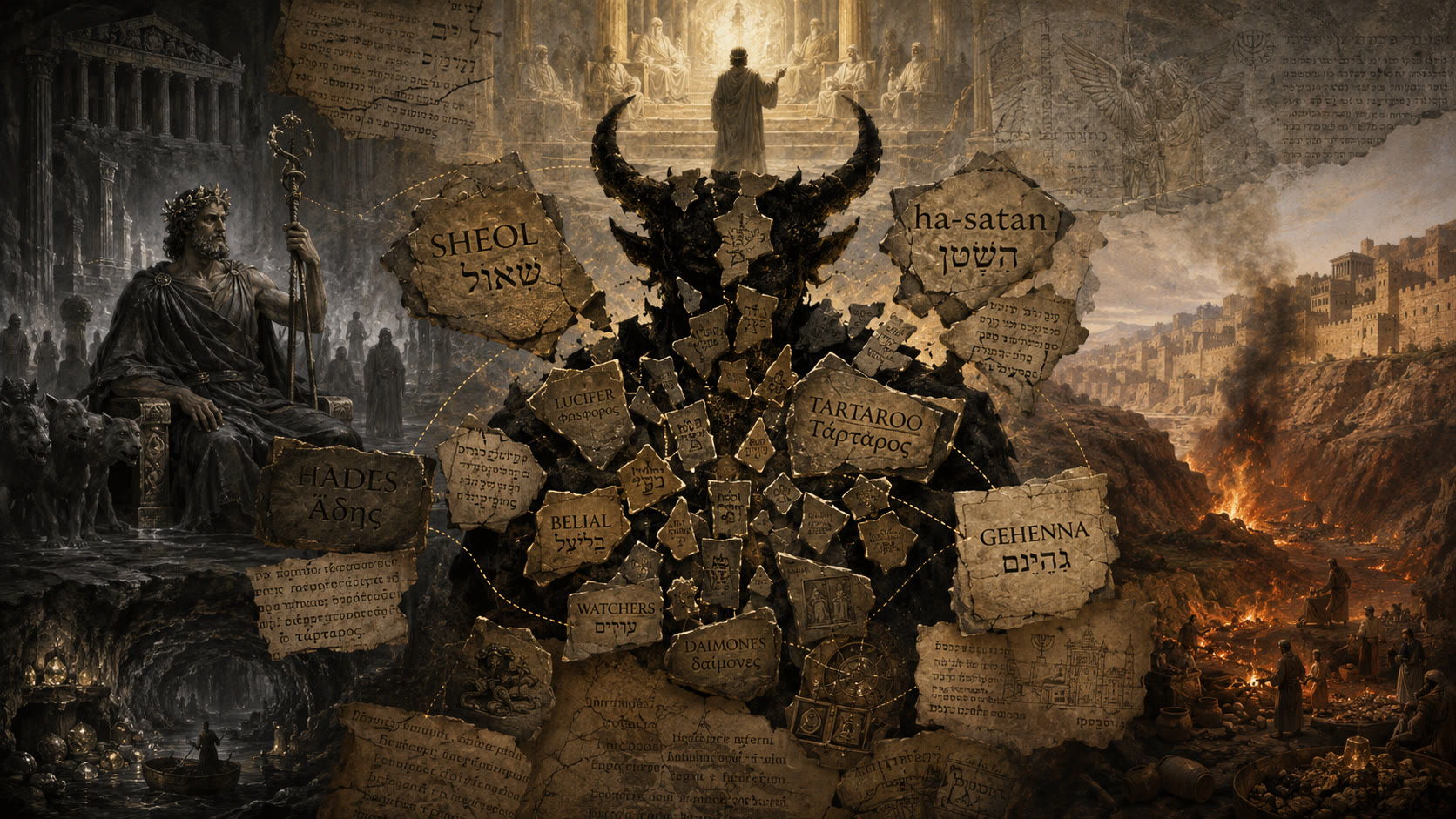
Open a King James Bible and search for hell. You will find it. Now open the Hebrew and Greek underneath and you will find four different words wearing that one English coat.
¶ Four words, one coat
Sheol. Hebrew, sixty-five occurrences. The KJV renders it hell thirty-one times, grave thirty-one times, pit three times. Same word every time. It is where the dead are. All of them, sorted by nothing. Jacob says he will go down to Sheol mourning for his son. Ecclesiastes says there is no work or knowledge or wisdom there. There is no fire in it, no punishment, no gate. It is the ground.
Hades. Greek, roughly ten occurrences in the New Testament. But this is not the Greek underworld arriving on its own terms. It is the word the Septuagint translators reached for three centuries earlier when they needed to render Sheol into Greek, and it carries Sheol's meaning forward, not Homer's.
Gehenna. Twelve occurrences, eleven of them from Jesus. This is the one with fire, and it is a place you could walk to. Ge Hinnom, the Valley of Hinnom, a ravine on the south side of Jerusalem where Jeremiah records children were burned at Topheth. When Jesus says it, his listeners could point.
Tartaroo. Once, in 2 Peter, a borrowed Greek verb about imprisoned angels. Not about human dead at all.
Four words. One coat. And the coat itself came from somewhere: hell is Germanic, cognate with Norse Hel, from a root meaning to cover or conceal. Translators poured four ancient concepts into a Norse container and handed it to English speakers as a single object.
So when someone tells you the Bible teaches hell, the honest question is which word. Because the Hebrew Bible has nothing that resembles the later doctrine at all.
¶ The god who was not the villain
Now take Hades, since he is the piece most people have met.
He is not a place in the oldest sources. He is a person. Homer writes Aidao domos, the house of Hades, and the possessive wore away over centuries until the name of a person hardened into the name of a location. Which means the Septuagint translators rendered a Hebrew grave with a Greek proper name. A location acquired a personality by translation.
And that personality is nothing like what has been done to it.
He did not seize the underworld. Iliad 15 has the three brothers divide the cosmos by lot: Zeus takes the sky, Poseidon the sea, Hades the misty dark, with earth and Olympus held in common. He is not a usurper. He is a shareholder who drew the short straw and kept his end of it.
His realm is not on fire. The Greek underworld is cold and dim, an asphodel meadow in gray half light. There are no flames anywhere in it. The fire belongs to a burning valley outside Jerusalem, and it got attached to him later by people who had collapsed the two.
He is not the enemy of the sky god. There is no adversary deity in Greek religion. The structure of cosmic good against cosmic evil is Persian, and it entered the Western imagination from a different direction entirely.
And his actual epithet is the one nobody quotes. Plouton, the rich one. Latin Dis Pater, the wealthy father. What lies under the ground is not only corpses. It is metal and seed. Plato has Socrates explain in the Cratylus that people call him by the wealth name because good things come up from below, and that they use the euphemism because they are afraid of the other name. Afraid, note, not disgusted. He was feared the way a boundary is feared.
Homer's word for him is ameilichos, unyielding. That is rigidity, not cruelty. He does not intervene, does not play favorites, does not break his own terms. He is the most rule bound figure in the pantheon.
The animated version with the flames and the scheming and the grudge against his brother is not a distorted Hades. It is a Devil wearing his name. Every element of it postdates Greek religion by centuries and comes from a composite assembled somewhere else.
¶ Where the composite came from
Here is the single cleanest piece of evidence, and it is one verse against another.
2 Samuel 24:1: the anger of the LORD burns against Israel, and he incites David to number the people.
1 Chronicles 21:1: a satan stood up against Israel and incited David to number the people.
Same census. Same sin. Same consequence. One author writes God as the agent. A later author, writing after the exile, moves the agency onto an accuser.
That is the seam. Somebody rewrote the sentence, and the rewriting happens precisely in the period when Judea sat inside a Persian empire whose religion had a vocabulary for exactly this problem.
But notice what the later author did not create. Not a name. The Hebrew is ha-satan, with the definite article, which is how you mark an office rather than a person. The satan. The accuser. A function in a court. In Job he is a member of the divine council reporting for duty, operating under explicit limits, doing a job. Rabbinic tradition preserves this: he carries out his part with a purpose, and one strand has him doing it for the sake of heaven, applying pressure so that righteousness can be demonstrated rather than assumed.
The Devil came later, and he came in pieces. The Watchers of 1 Enoch. Belial at Qumran. Helel ben Shachar in Isaiah 14, who is the king of Babylon in his own text until Jerome renders him Lucifer. Ezekiel's king of Tyre. The chaos dragon. Greek daimones, morally neutral spirits, flattened into demons. Gehenna's fire. Hades' realm and eventually Hades' name.
Nobody sat down and invented him. He accreted. And once he existed, he was retrofitted backward onto every prior underworld figure within reach, which is how a rule bound Greek shareholder ended up with horns.
¶ Even the Persian one is not a devil
You would expect the tradition everyone accuses of dualism to supply the Devil. It does not.
Yasna 30.3, the oldest layer, names two twins: Spenta Mainyu and Angra Mainyu. Bounteous mentality and destructive mentality. Read the pairing carefully. The opposition is not Ahura Mazda against Angra Mainyu. It is between two mentalities, with Ahura Mazda standing above the pair. Angra Mainyu is not God's rival. He is the rival of God's own spirit, one tier down.
And mainyu is mind, mentality, disposition. Yours is one too. Yasna 30.5 has the destructive one choosing the worse, which makes this an account of election, not of substance. Evil is what a mind does, not what a thing is.
The later Pahlavi books look more symmetrical, and that is where the dualism charge finds purchase. But even there it collapses on inspection. Ahriman has only hind knowledge. He cannot see the end. The entire contest is a bounded twelve thousand year trap designed by Ohrmazd who knows how it finishes. A player who cannot see the board is not an equal.
And his ending is the part worth sitting with. The Pahlavi doctrine is that Ahriman has no existence in getig, the material state, only in menog. The whole cosmic strategy is to draw him into materiality where he can be held and undone. He dissolves at the end because there was never anything substantial there to begin with.
Meanwhile the final restoration, Frashokereti, is universal. Everyone passes through the molten metal. To the righteous it feels like warm milk. Everyone comes out. There is no permanent hell in the system, and no one is discarded.
¶ The distinction that actually matters
None of this is an argument that severity is soft.
The Kabbalistic tradition has a name for the other side, sitra achra, and the word achra means other. External. Outside. What the tradition marks with that name is not the holy left, not Gevurah operating inside the structure. It is what has gone outside the structure entirely.
And the Zohar's account of how it gets there is an account of a choice. The primal sin is kitzutz ba-netiot, cutting the shoots: separating the Tree of Knowledge from the Tree of Life, taking judgment apart from what held it. Before that act the other side is bounded and has no purchase. After it, it has one. And it stays fed the same way, by human acts, because it has no supply of its own.
So the husk has less standing than Angra Mainyu, not more. Angra Mainyu at least chose for himself. The husk does not elect anything. It is actualized by someone else's choosing and eats what it is handed.
Which leaves the distinction intact and sharper than before. Severity inside the structure is holy. It is the limit that gives a life edges, the constriction that makes disclosure possible, the refusal to make exceptions that is what a boundary is. Severity cut loose from the structure, handed a proper name and an independent will, is the distortion. Not a rival god. Not a second power. A costume with nothing inside it.
That is what happened to ha-satan. An office was detached from its court, given a name, and issued a will it never had.
And it is what happened to a Greek god who kept his terms, held his jurisdiction, and gave the world its grain.
Full argument, sources, and tier conventions: The Library That Does Not Burn, Foundation of Asha. Released CC BY 4.0.
¶ Related
More from the sourced library:
Get one recovered thing a week.
Sourced religious history, tier-honest, never fabricated. Start with the free book, The Fire and the Veil (PDF, DOI-archived).
Free. One email a week. Unsubscribe anytime. No spam, no fabrication.There is a world you can walk into.
Athena’s Palace is a living world — an agora where positions are argued and settled, a plaza you share with whoever else is awake, and dozens of games besides. Free in your browser, no account needed.
Enter Athena’s PalaceOr go straight there: athenaspalace.comDiscuss this with people who read it too.
Foundation of Asha keeps a Discord for readers working through the Map of Consciousness, the Zohar, the Gospels and the Avesta — five years of archived discussion, and a room that answers.
Join the DiscordPermanent invite: discord.gg/npZ6kBzPj5Reader-funded. No ads, no paywall, no fabrication.