The Fire & the Veil · Foundation of Asha
When Did Jews Stop Pronouncing YHWH? When the Name Left the Mouth
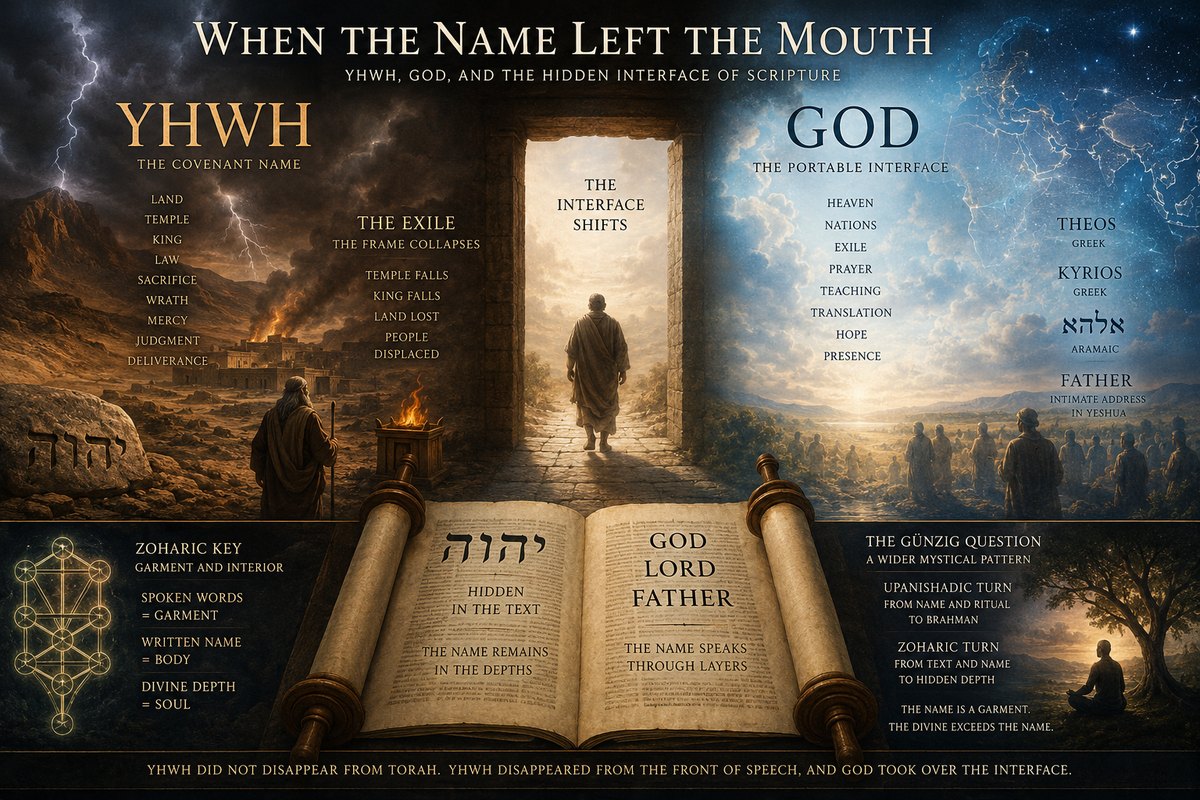
YHWH, God, and the Hidden Interface of Scripture
¶ The shift that later tradition smooths over
There is a change inside biblical religion that is easy to miss, because the tradition that inherited it learned to read past it. The change is not that Israel abandoned its God. It is not that YHWH was quietly swapped for a different deity. And it is not that nothing happened — that the name simply stayed important and the story is one of seamless continuity.
Something did change. The interface changed.
YHWH remained inside the scripture. But the mouth moved elsewhere. Ordinary speech, teaching, translation, and prayer drifted away from the raw covenant name toward broader forms — God, Lord, and, by the time of Yeshua, Father. Not a change of deity. A change of access. A change of address. A shift in how Israel's God could be spoken, carried, translated, and encountered after the old world fell apart.
This essay is the companion to The Garment and the Abyss, which argued that the named God of scripture is the interface layer of an unnameable depth. Here that thesis meets its hardest test case: the four letters of the divine Name itself, YHWH — and the long, documented process by which they slipped off the front of speech.
¶ YHWH is not simply "God"
The first mistake is treating YHWH as if it were just the Hebrew word for the English "God." It is not. YHWH is a name — specifically the covenant name of Israel's deity, and it carries history: land, temple, law, kingship, wrath, mercy, jealousy, judgment, battle, deliverance, exile, and national memory.
Hebrew already had general terms for divinity, and they behave differently. El is the old common-Semitic word for a god, rooted in a sense of power; Elohim (grammatically plural, used of Israel's God with singular agreement) is the broad word for God; Adonai means "Lord." YHWH is none of these. It is not an abstract category or a philosophical title. It is the charged proper name of divine contact inside Israel's historical drama. YHWH commands, burns, judges, delivers, punishes, restores, and binds a people to covenant.
That is a very different instrument from "God" as a universal title. The word God travels. It can become philosophical, moral, universal; it can be translated across languages and empires; it can function outside the land, outside the temple, outside the monarchy. YHWH is particular. God is portable. And the history of Jewish and Christian speech about the divine is, in part, the history of that translation.
¶ The Exile cracked the frame
The first force that pushed the tradition toward portable language was the Babylonian Exile.
In 586 BCE Nebuchadnezzar II razed Jerusalem and burned the Temple. The older world had rested on land, temple, king, law, and sacrifice, with YHWH bound to that world as the primary interface of divine encounter. Babylon shattered the frame: the temple fell, the king fell, the land was lost, the people were carried off. This was not only a political catastrophe but a theological one (Mark S. Smith, The Origins of Biblical Monotheism, 2001; Rainer Albertz, Israel in Exile).
In the ancient Near East a defeat like this carried a standard verdict: your god lost. If an empire burns your temple, then its god beat yours, or your god abandoned you, or your god was never as strong as claimed. Israel's tradition refused that verdict — but it did not return unchanged to the old mode. Instead, in the exilic prophet known as Deutero-Isaiah (Isaiah 40–55), the divine is recast as a God who is not bound to a place at all: who used Babylon and names the Persian Cyrus as his instrument (Isaiah 44:28; 45:1), before whom the gods of the nations are nothing. This is widely read as the sharpest articulation of full monotheism in the Hebrew Bible — and notably, it is monotheism in portable dress: God of heaven, God of all nations, a God who can be worshipped in exile, who survives the loss of the temple. (Honest tier note: that monotheism crystallized mainly in the exile is the mainstream scholarly view, not a unanimous one; some argue for earlier monotheizing strands.)
So the Exile is the first current. It did not silence the Name. It made God-language — broad, translatable, universal — newly necessary.
¶ The Name goes silent — a second, later current
The second force is distinct from the first, and getting the relationship right matters, because it is exactly where careless versions of this story overreach.
The Exile collapsed the temple-and-land frame. But the cessation of pronouncing YHWH — the name literally leaving the mouth — is a separate development, and a later one. The scholarly consensus dates the avoidance of pronunciation not to the Exile itself but to the Second Temple / Hellenistic period, taking firm hold especially from around the third century BCE and reaching completion around the Temple's destruction in 70 CE, driven by reverence and fear of profaning the holy Name (Britannica, "Yahweh"; Larry Hurtado, "Writing & Pronouncing the Divine Name in Second-Temple Jewish Tradition"). The Mishnah remembers the transition: on the Day of Atonement the High Priest still pronounced the Name aloud, and the people prostrated (Yoma 6:2) — a memory of a time when it was spoken, in one place, by one man, on one day.
The substitution left a fingerprint that survives in every Hebrew Bible. The Masoretes preserved the consonants YHWH but pointed them with the vowels of Adonai — a "perpetual qere," a silent instruction: do not say what is written; read "Adonai." (The later misreading of that hybrid is where the form "Jehovah" came from.)
The Greek side carries the same honesty-demanding nuance. The Septuagint came to render the Name as Kyrios ("Lord"), and that became the standard — but largely in later, Christian transmission. The earliest surviving Greek fragments do something else: 4Q120, a Greek Leviticus from Qumran (first century BCE), writes the Name as ΙΑΩ (Iaō), and Papyrus Fouad 266 inserts the Hebrew letters straight into the Greek. (Albert Pietersma has argued the original translators used Kyrios and the Hebrew-name copies are a later archaizing revision; this is a real but contested position. The safe statement is the modest one — however it was written, Greek-speaking Jews almost certainly read aloud a spoken substitute.)
Two independent rivers, then, reaching the same estuary: the Exile pressed the tradition toward portable God-language; Second-Temple reverence pressed the covenant name out of speech. By Yeshua's day the living language of address is God, Lord, and Father — and the four letters have become something written, central, and unspoken.
¶ Concealment, not erasure
It is tempting to flatten that into a secular story: the old name became obsolete and got replaced. But a name that is no longer ordinarily spoken is not therefore dead. It can remain written, central, and hidden inside scripture — the deep name behind the system, even as the mouth says Lord.
This is where the Zohar gives a better grammar than replacement theory. The Zohar does not read Torah as mere surface; it reads it as garment, body, and soul — the stories clothe a hidden meaning, the visible text conceals an inner fire (Zohar III:152a; see Gershom Scholem, "The Meaning of the Torah in Jewish Mysticism"). The same logic fits the Name almost exactly:
- The spoken substitutes — Adonai, Lord, God — are the garment.
- The written Name is the hidden body.
- The divine depth beyond even the Name is the soul.
This does not make the garments fake. Garments matter; without them the inner meaning never appears in the world. But the garment is not the deepest layer. So the move from YHWH-in-direct-address toward God, Lord, and Father is best framed not as the old name became obsolete and not as nothing changed — but as: the Name withdrew from ordinary speech and became interior to the tradition, while broader titles became the public garments through which the tradition kept speaking. That keeps the historical shift without insulting the mystics, and without pretending the shift was nothing.
¶ God becomes the portable interface
God-language can do what YHWH-language cannot easily do. It crosses borders. It enters Greek as Theos, Aramaic as Elaha (the word Yeshua's own milieu would have used), Arabic later as the cognate ilāh. It can be spoken by diaspora communities across empires, become metaphysical without losing its tether to scripture, and survive the loss of every external anchor.
So the tradition never had to abandon Israel's God to change its operating language. It preserved the referent while changing the interface:
- YHWH remains the deep covenant name, written and unspoken.
- Adonai becomes the spoken "Lord."
- Elohim is the broad God-title.
- Theos and Kyrios carry the tradition into Greek.
- Elaha carries the Aramaic world.
- Father becomes the intimate address in Yeshua's teaching.
This is not a random pile of synonyms. It is a layered system of access: written depth, spoken substitution, universal title, translation layer, relational address.
¶ Yeshua speaks from the later interface
Yeshua does not stand outside this. He quotes Jewish scripture, invokes Israel's God, and speaks from inside the world that Torah, prophets, synagogue, and Second-Temple hope had built. But he does not foreground YHWH as the ordinary name of address. His dominant register is Father — preserved even in Aramaic in the Gospel tradition (Abba, Mark 14:36; echoed in Romans 8:15 and Galatians 4:6).
One careful correction belongs here, because it is a famous overreach. Joachim Jeremias argued that Abba was childish baby-talk — essentially "Daddy." James Barr decisively refuted this in "Abba Isn't 'Daddy'" (Journal of Theological Studies 39, 1988): Abba is warm and familiar, but it is "a more solemn, responsible, adult address to a Father," not a toddler's word; the nuance is Father, not Daddy (a verdict since echoed by Vermes and others). So the point stands without the sentimental gloss: Yeshua's habitual address is intimate, filial, and direct — Father — and that shifts the emotional structure of the divine toward nearness, mercy, and dependence.
Not a different deity. A different interface. The God of Israel is still the referent, but the YHWH storm-and-covenant register is no longer the dominant note; the language has passed through exile, reverent substitution, Greek translation, Aramaic prayer, and inner devotion, and Yeshua intensifies one strand of it: Father.
¶ Not Marcion, not flattened orthodoxy
There are two bad simplifications, and the truth sits between them.
The first is Marcionite: that the Father of Yeshua is simply a different God from the God of Israel. That is too crude — Yeshua is Jewish, his scripture is Jewish, his God is Israel's God. (Marcion's second-century attempt to sever them is the classic version of this error.)
The second is flattening: that there was no meaningful shift at all, only one continuous name for one unchanging idea. That is too easy.
The honest description is sharper than both: continuity of referent, discontinuity of interface. The tradition keeps speaking of Israel's God — but the way that God is named, approached, translated, and emotionally experienced changes profoundly. YHWH is not erased. YHWH is not merely promoted into a bigger concept. YHWH is simply no longer the everyday front end. The front end becomes God, Lord, and Father. The name moves inward; the public interface moves outward.
¶ The Günzig question: a wider pattern
This is where a comparison becomes useful — and dangerous, if made carelessly. In 1900 the rabbi-scholar Asriel Günzig argued, in a Hebrew essay in Ha-Eshkol, for a "wonderful resemblance" between Jewish mysticism and Indian metaphysics (discussed today by Boaz Huss). The reckless reading of that instinct says Kabbalah came from India. The defensible reading says something smaller: that both traditions sometimes recognize the same structural problem — that the divine name is not the end of the divine.
In the Indian material, the older world of gods, ritual, and sacred speech turns inward toward Brahman and Atman: the visible form is not discarded, but it is no longer the final layer (neti, neti — "not this, not this," Bṛhadāraṇyaka Upaniṣad 2.3.6; tat tvam asi — "that thou art," Chāndogya 6.8.7). The Zohar makes a formally similar move inside Torah: it keeps the text and the names, and insists the deepest layer lies beneath the garment.
That is the link — and only that. Not that Torah came from India. Not that the Zohar copied the Upanishads (Scholem rooted Kabbalah inside Judaism, in Gnostic and Neoplatonic currents, not the East). Not that YHWH equals Brahman. The honest, Günzig-friendly formulation: when the most charged name leaves the mouth, a purely historical answer says the interface changed; a Zoharic answer says the name moved inward; and a comparative answer notes that this inward movement resembles a wider mystical instinct — the sacred name becomes a garment, and the divine depth waits behind it. Both traditions know the same danger: stopping at the name. The name is powerful and necessary. It is not the final depth. The divine exceeds the name by which it is addressed.
¶ What can be proven, and what cannot
To keep this honest, the claims sort by strength.
Strong (historical-linguistic). That the spoken interface shifted — from the covenant name toward Adonai/Lord, Elohim/God, Theos and Kyrios in Greek, and Father in Yeshua's register — is well documented: the qere perpetuum, the Mishnah's memory of the High Priest, the Greek manuscript record, and the Gospel's preserved Abba. This is the essay's actual claim.
Carefully dated. The Exile (586 BCE) catalyzed portable God-language; the silencing of the Name is a distinct, later, Second-Temple reverence development. Conflating the two is the most common error, and the essay does not.
Structural, not genealogical. The resemblance to the Upanishadic turn is a comparison of form — surface giving way to a nameless depth — not evidence of historical contact, and not a claim the two traditions mean the same thing at the bottom. (Where they differ is real: see the companion essay.)
¶ The clean thesis
After the Exile, the older YHWH-centered interface became increasingly hard to carry unchanged, and Second-Temple reverence drew the covenant name out of ordinary speech. The tradition preserved the Name in the written text while its living language moved toward broader, portable forms — God, Lord, and finally Father.
This was not a change of deity. It was a change of interface. Read historically, it is a shift in public address. Read through the Zohar, it is concealment — the Name as hidden interior, the titles as public garment. Read through Günzig's comparative instinct, it is one instance of a wider pattern: the name becomes a garment, and the hidden divine depth remains beyond it.
YHWH did not disappear from Torah. YHWH disappeared from the front of speech — and God took over the interface.
¶ Sources
Primary
- Mishnah Yoma 6:2 — the High Priest pronouncing the Name on the Day of Atonement.
- Tanakh: Isaiah 40–55 (esp. 44:28; 45:1, Cyrus); the Masoretic qere perpetuum for the Tetragrammaton.
- Greek witnesses: 4Q120 (pap4QLXXLev^b, ΙΑΩ); Papyrus Fouad 266 (Hebrew Tetragrammaton in a Greek text).
- Zohar III:152a — the garment / body / soul doctrine of Torah.
- Bṛhadāraṇyaka Upaniṣad 2.3.6 (neti neti); Chāndogya Upaniṣad 6.8.7 (tat tvam asi).
- New Testament: Mark 14:36; Romans 8:15; Galatians 4:6 (Abba).
Secondary
- Mark S. Smith, The Origins of Biblical Monotheism (Oxford UP, 2001); Rainer Albertz, Israel in Exile — the exile and the articulation of monotheism.
- Larry W. Hurtado, "Writing and Pronouncing the Divine Name in Second-Temple Jewish Tradition" and "YHWH in the Septuagint" — the dating of the name-avoidance and the LXX manuscript picture.
- Albert Pietersma, "Kyrios or Tetragram" — the (contested) case for an original Kyrios.
- Gershom Scholem, "The Meaning of the Torah in Jewish Mysticism," in On the Kabbalah and Its Symbolism (1965).
- James Barr, "Abba Isn't 'Daddy'," Journal of Theological Studies 39, no. 1 (1988): 28–47 — the refutation of the "Daddy" gloss.
- Asriel Günzig, "Kabbalah and Indian Philosophy," Ha-Eshkol 3 (1900): 40–48; discussed in Boaz Huss, "Hindu and Jewish Mysticism" (2022).
Method note: claims are tiered. The shift in spoken interface (strong) is documented; the Exile-vs-name-cessation distinction is kept deliberately (the cessation is Second-Temple, not exilic); the comparative resemblance is structural, not a claim of historical contact or identity.
¶ Related
More from the sourced library:
Get one recovered thing a week.
Sourced religious history, tier-honest, never fabricated. Start with the free book, The Fire and the Veil (PDF, DOI-archived).
Free. One email a week. Unsubscribe anytime. No spam, no fabrication.There is a world you can walk into.
Athena’s Palace is a living world — an agora where positions are argued and settled, a plaza you share with whoever else is awake, and dozens of games besides. Free in your browser, no account needed.
Enter Athena’s PalaceOr go straight there: athenaspalace.comDiscuss this with people who read it too.
Foundation of Asha keeps a Discord for readers working through the Map of Consciousness, the Zohar, the Gospels and the Avesta — five years of archived discussion, and a room that answers.
Join the DiscordPermanent invite: discord.gg/npZ6kBzPj5Reader-funded. No ads, no paywall, no fabrication.