The Fire & the Veil · Foundation of Asha
The ICC Fight Is Bigger Than Netanyahu
Sovereignty, the Rome Statute, and the question underneath the warrants.
¶ The ICC Fight Is Bigger Than Netanyahu
Trump's comments about the ICC look, at first glance, like another Israel story.
And they are.
The ICC issued arrest warrants for Benjamin Netanyahu and Yoav Gallant over alleged crimes in Gaza. Trump's administration says the court has no jurisdiction over Americans and will not cooperate with ICC investigations.
So the obvious read is simple: Trump is protecting Netanyahu.
That is true. But it is not the whole thing.
The bigger fight is not just Trump versus the ICC, or Netanyahu versus the ICC, or Israel versus Palestine.
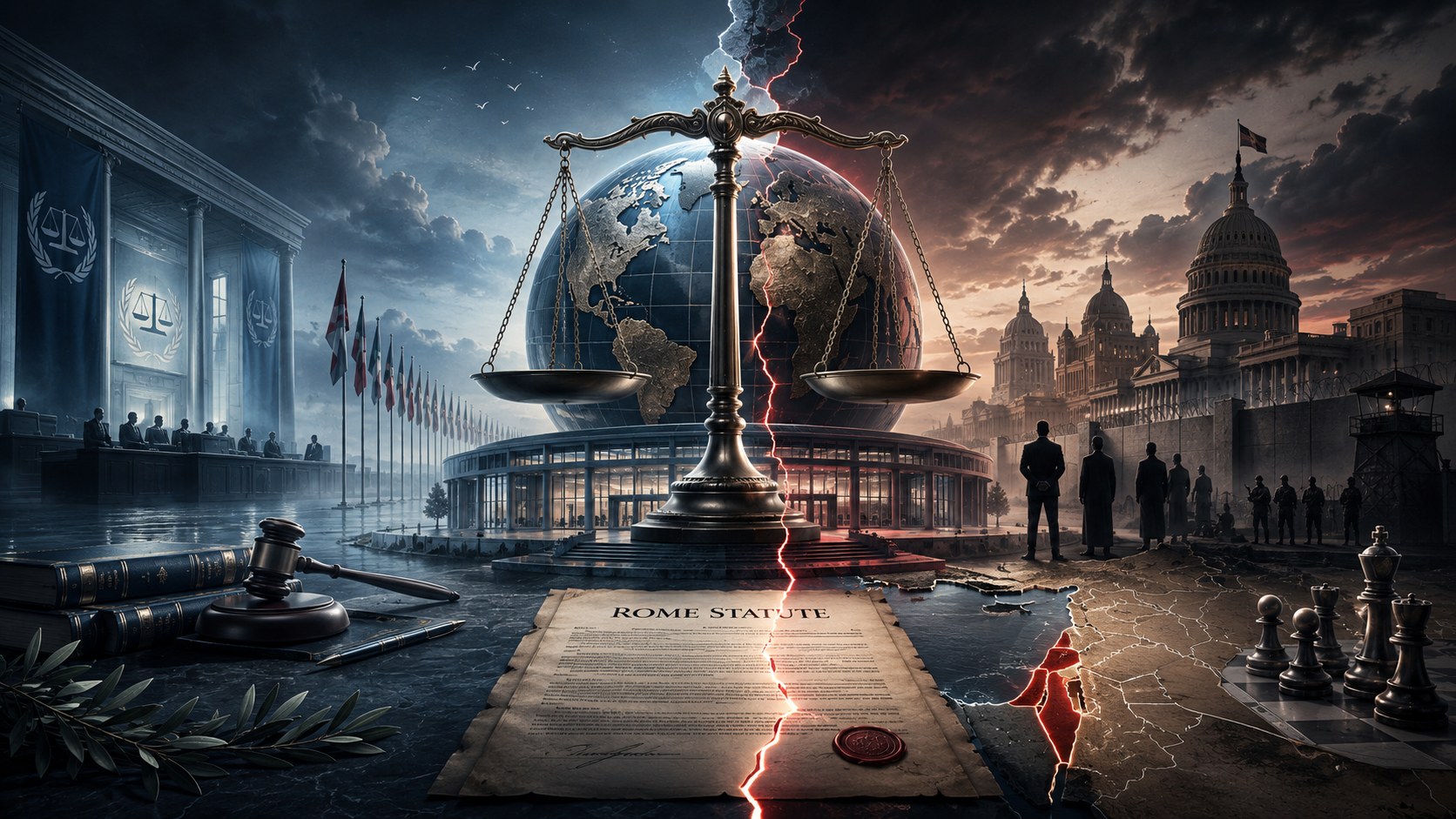
The bigger fight is whether any supranational court can sit above powerful states that never consented to its authority.
That is the real fault line.
For a long time, I thought the ICC was basically the anti-Netanyahu mechanism. I thought Palestine was the case that would finally let international law reach a leader who otherwise seemed untouchable.
But that framing misses the deeper structure.
The United States is not a party to the Rome Statute.
Israel is not a party to the Rome Statute.
Russia is not a party to the Rome Statute.
China is not a party to the Rome Statute.
That means the ICC is not simply a "West versus East" institution, and it is not simply a "Trump and Netanyahu versus China and Russia" story.
China may like ICC pressure on Netanyahu when it weakens Israel, the U.S., or the West. Russia may like ICC rhetoric when it is pointed at its enemies. The U.S. may hate the ICC when it is pointed at Americans or allies. Europe may defend the ICC because it is built into its postwar legal order.
But underneath the rhetoric, the real issue is sovereignty.
The ICC represents a claim that some crimes are so grave that they can pierce national protection.
Great powers hear something else.
They hear: "Your officials, soldiers, allies, and national decisions may one day be judged by a court you do not control."
That is why Palestine matters so much.
Palestine is not just a moral case. It is a jurisdictional doorway.
Because Palestine joined the Rome Statute, the ICC argues that crimes committed on Palestinian territory can fall under its jurisdiction, even if the accused are from a non-member state like Israel.
That is the move that terrifies sovereign powers.
Not because every great power agrees with Netanyahu.
They do not.
But because every great power understands the precedent.
If the court can reach Israeli leaders through Palestinian territory, then what stops similar logic from being used against Americans, Russians, Chinese officials, or any other powerful state operating beyond its own borders?
That is the real game.
For supporters of the ICC, this is the whole point. Nobody should be above accountability. A state should not be able to bomb, starve, torture, invade, or displace people and then hide behind sovereignty.
For opponents of the ICC, this is the danger. A court that is not democratically accountable to your people can claim authority over your citizens, your soldiers, your leaders, and your foreign policy.
Both sides understand the stakes.
That is why this is bigger than Netanyahu.
Netanyahu is the immediate case.
Palestine is the legal doorway.
The ICC is the institution.
But the real question is older and larger:
Who rules when the state itself is accused?
The nation?
The treaty system?
The court?
The empire?
The global legal order?
That is the click.
China is not "pro-ICC" in principle.
The U.S. is not simply "anti-justice" in every case.
Europe is not merely "pro-Palestine" here.
Israel is not the only issue.
Everyone is using the language of law, morality, sovereignty, and human rights. But underneath that language is a structural fight over whether the modern nation-state remains the highest political authority, or whether some crimes create a higher jurisdiction above it.
That is why the ICC scares powerful countries.
Not because it is always effective.
Because if its theory wins, sovereignty is no longer absolute.
And once sovereignty is no longer absolute, the question becomes:
Who gets to decide when it can be pierced?
It turns out humanity has been asking that exact question for about four thousand years, and the traditions that asked it first left receipts. That longer read is here: Who Judges the King?
This is the accessible companion to a sourced essay; the factual claims (the warrants, the treaty parties, the jurisdictional theory, the administration's stated position) are verified against the public record as of July 3, 2026.
→ Read the book: The Fire and the Veil (free, with a DOI: https://doi.org/10.5281/zenodo.20619291).
Sources: the Rome Statute and its state-parties record (US, Israel, Russia, China non-parties); ICC Pre-Trial Chamber I warrants for Netanyahu and Gallant (Nov 21, 2024); Palestine's accession to the Rome Statute (2015) and the territorial-jurisdiction theory; US DOJ letter to the ICC President (June 29, 2026) stating non-cooperation and rejection of jurisdiction over U.S. persons. CC BY 4.0.
Get one recovered thing a week.
Sourced religious history, tier-honest, never fabricated. Start with the free book, The Fire and the Veil (PDF, DOI-archived).
Free. One email a week. Unsubscribe anytime. No spam, no fabrication.There is a world you can walk into.
Athena’s Palace is a living world — an agora where positions are argued and settled, a plaza you share with whoever else is awake, and dozens of games besides. Free in your browser, no account needed.
Enter Athena’s PalaceOr go straight there: athenaspalace.comDiscuss this with people who read it too.
Foundation of Asha keeps a Discord for readers working through the Map of Consciousness, the Zohar, the Gospels and the Avesta — five years of archived discussion, and a room that answers.
Join the DiscordPermanent invite: discord.gg/npZ6kBzPj5Reader-funded. No ads, no paywall, no fabrication.