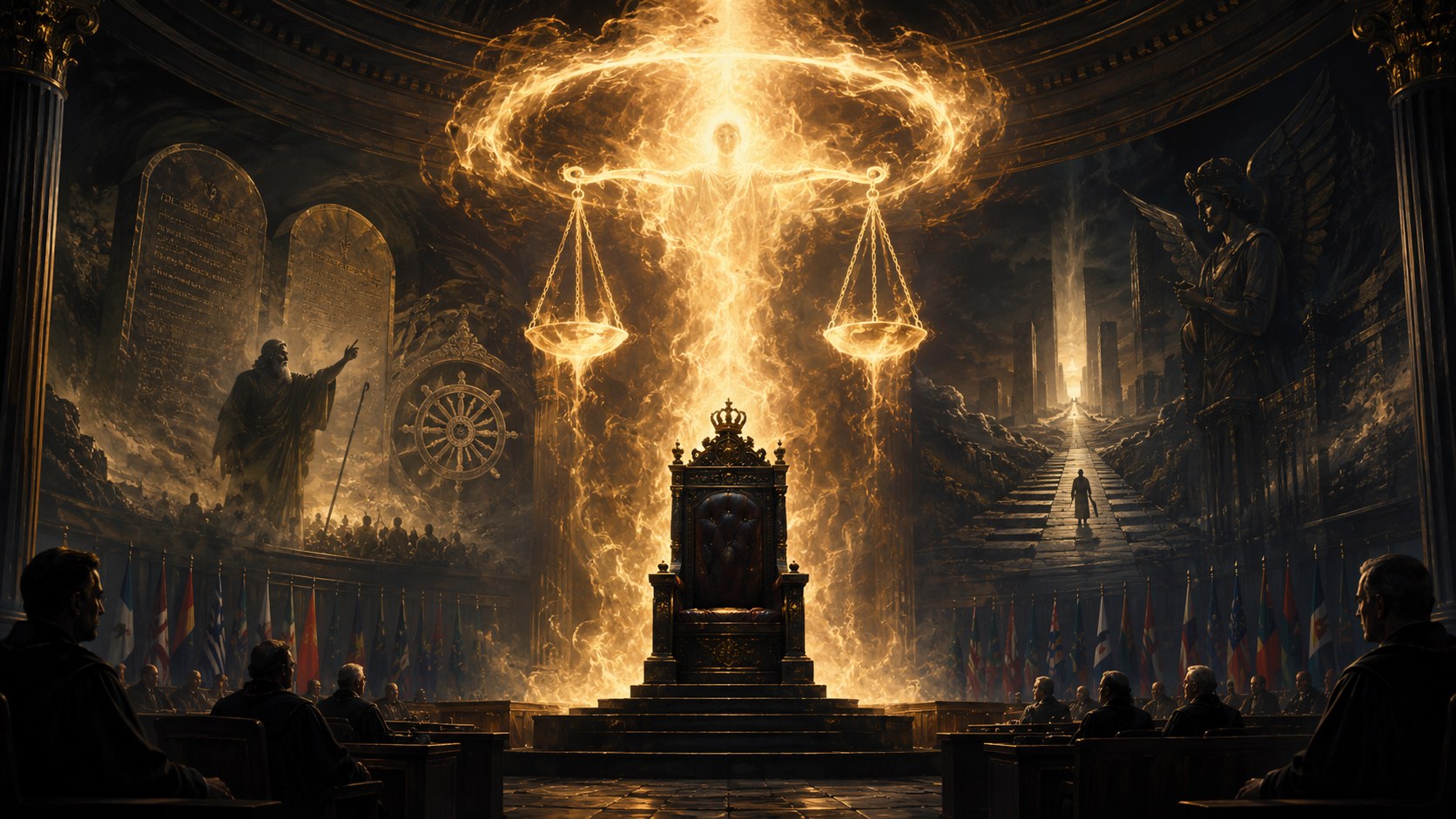
The Fire & the Veil · Foundation of Asha
Who Judges the King? The ICC Fight, Read by Older Light
Psalm 82 with a docket number: what four thousand years of tradition say about a court that reaches the throne.
¶ Who Judges the King?
The ICC fight, read by older light.
"I said, you are gods, sons of the Most High, all of you. Nevertheless you shall die like men, and fall like any prince." Psalm 82
This week the United States Department of Justice sent a letter to the president of the International Criminal Court. It described the court as acting in an "increasingly lawless and illegitimate manner" and called any attempt to assert authority over U.S. persons a direct affront to American sovereignty. The letter was dated June 29. It arrived days after three of the court's own judges filed suit in a Manhattan federal courtroom, asking an American judge to protect them from the American treasury.
Hold that image a moment. Judges of the tribunal built in Nuremberg's shadow, the court of last resort for genocide and crimes against humanity, petitioning a national court for relief from sanctions designed for cartel financiers and terror networks. Since February 2025 the sanctions machinery has designated at least eleven of the court's officials, eight judges, the chief prosecutor, and two of his deputies among them, and reached outward to the human rights organizations that bring the court its evidence, including three Palestinian groups last September. Designation means exile from the dollar. Banks close the accounts. Anyone on earth who provides a designated person funds, goods, or services risks the same fate, because every institution that touches the American financial system must comply. The court, anticipating the siege, paid its staff three months of salary in advance, the way a household lays in flour before a war.
Here is the tell that gives the game away. In 2023 the same court, on the same jurisdictional theory, issued a warrant for Vladimir Putin, and Washington applauded. The theory is simple: the court may try crimes committed on the territory of its member states regardless of the passport of the accused. Ukraine invited the jurisdiction. Afghanistan is a member. Palestine is treated as one. When the theory produced a warrant for an adversary, it was justice. When it produced a warrant for a client, it became, overnight, lawless. Nothing in the law changed between the two warrants. Only the direction it pointed.
So the objection is not legal. It is doctrinal, and the doctrine is now stated in plain language: no court sits above this throne.
And here is the second tell. The rival empire agrees. China voted against the Rome Statute in 1998 and never joined. When the court indicted Putin, Beijing lectured the world on the immunity of heads of state. When it indicted Netanyahu, the immunity principle was nowhere to be found; the tone warmed, since the warrant embarrassed the West. When the court took custody of Duterte, a friend, the old mantra returned: prudence, no politicization, no double standards. Beijing condemns the American sanctions, but as a genre, unilateral measures lacking Security Council authorization. It never defends the court's actual claim. It cannot, because it holds the American doctrine to the letter. Russia, for its part, withdrew its signature and put the court's prosecutor on its own wanted list. These powers agree on almost nothing. They agree on this: judgment must not run uphill.
Even the court's birth certificate concedes the point. The Security Council may refer a situation to the prosecutor, and any permanent member may veto a referral aimed at itself or its clients, which Russia and China did for Syria in 2014. The gods convened in council and exempted themselves by procedure. Psalm 82 with a docket number.
Strip away the vocabulary of statecraft, jurisdiction, sovereignty, national security, and what remains is not a twenty-first-century question. It is the oldest question the religious imagination ever asked. Who judges the king?
Mesopotamia gave the ancient answer. On the stele, Hammurabi receives the law from the sun god and hands it downward. The king is the law's administrator to everyone beneath him and its subject to no one above him, because there is no one above him. Law flows downhill from the throne. This is the natural religion of power, and it has never needed missionaries.
Israel's answer was a revolution disguised as a scribal rule. Deuteronomy commands that the king write out a copy of the law with his own hand and read it all the days of his life, so that his heart is not lifted above his brothers. The law precedes the throne and outranks it. When David takes Bathsheba and arranges Uriah's death, the machinery of state produces no indictment; a prophet walks into the throne room with a story about a stolen lamb and says: you are the man. When Ahab takes Naboth's vineyard through judicial murder, Elijah is already waiting in the vineyard. The prophet is the appellate court the king cannot sanction. And when the great thrones of that age announce the modern doctrine in its ancient form, Pharaoh declaring the river is mine, I made it, Babylon declaring I will make myself like the Most High, the oracles record those speeches as obituaries.
The rabbis gave the principle a calendar: a day each year when the King of Judgment reviews every soul without exception, no veto available, no counsel designated. The Kabbalists gave it an anatomy. On the Tree, Gevurah is the left hand, the fire of Isaac, severity, restraint, the power that says no; its angel is Khamael, the scourge of discipline. And at the center of the Zohar's moral cosmology sits a warning that reads as if drafted for this news cycle: severity severed from mercy is the root of the Other Side. Judgment that flows in one direction only, downward, is not justice but its husk. A qlippah: a shell with the shape of the fruit and none of the life. If you want the tradition's precise name for a legal order that reaches the weak and exempts the strong, there it is. Not law. The shell of law, animated from the wrong side. And even Gevurah does not judge alone. The Zohar speaks of the divine fire as a fire that consumes fire, flame above flame, judgment standing under judgment, all the way up. No seat at the top of that column is open for purchase.
Zoroaster, the oldest voice in this choir, refused to make judgment an institution at all. He made it a substance. Asha is truth, right order, the grain of reality; Druj is the Lie. Every soul, herdsman and king of kings alike, comes to the Chinvat crossing and meets its own record walking toward it; the bridge widens to a road or narrows to a blade's edge according to what you are, not what you decreed. And at the world's renovation the mountains melt and run as a river of metal through which everyone passes, and the same river is warm milk to the truthful and fire to the liar. There is no veto in this cosmology, no designation list, no letterhead. You cannot sanction a river.
India said it with a jurist's economy. Dharma, says the Brihadaranyaka Upanishad, is the power over power, the rule above rulers. Then comes the sentence that explains this entire news cycle: by dharma the weak prevail over the strong, as through a king. Read it twice. Law is the strength of the weak. That is why the middle powers of Europe fund the court and the empires starve it; the strong have never needed law, only obedience. And when an emperor did submit, Ashoka after the slaughter at Kalinga, he did not claim the wheel. He placed himself under it. Karma, meanwhile, remains the one court no treasury has ever de-banked.
Islam carries the doctrine in its daily breath. Yawm ad-Din, the Day of Judgment; the Arabic din and the Hebrew din are the same old Semitic word. A billion people recite Master of the Day of Judgment seventeen times a day, a daily notarization that the mastery belongs to no one in a palace. The caliph, in the theory, is a steward and not an owner, holding the earth on a lease whose terms he did not write.
And the Galilean strand. A peasant girl sings that the mighty are pulled down from their thrones before her son is born. The son, standing bound before the empire's governor, tells him his authority is on loan from above. The founding scene of that faith is a king being judged by an empire, and the verdict reversing on appeal, in a higher court, three days later.
These traditions agree on almost nothing. God, the self, time, the afterlife: choose any doctrine and they will fight about it. On this one structure they are unanimous. Every one of them keeps a fire above the throne. They differ on what the fire is, who tends it, when it falls. Not one of them permits the claim now issued on official letterhead from Washington and held with better manners in Beijing: that above this particular throne there is nothing.
None of which sanctifies the court in The Hague. For twenty years its own docket ran downhill; it reached warlords and the defeated while its funders' wars went unexamined, and the veto asymmetry was written into its charter on the day it was born. The ICC is not the fire. It was, at best, a rumor of the fire: an attempt to cast in procedure what the traditions carried in story, the idea that war criminal names conduct rather than rank. The attempt is now being strangled in its robes, and it may die. Inside the empire, what remains of the uphill channel is a pair of American court rulings protecting, for now, citizens' right to speak to the tribunal. A permission to talk. That is the residue.
But watch the kings, because their behavior confesses what their letters deny. For two decades the strong ignored this court, which is how power treats what it does not fear. Now they sanction the judges one by one, send formal correspondence declaring the court a nullity, litigate against their own citizens for speaking to it. You do not write letters to a thing you believe has no authority. The fury is not proportionate to the court's power, which is nearly zero. It is proportionate to the claim, which is total: that the law reaches the throne. A certain kind of throne finds that claim intolerable not because it is enforceable but because it is true in a register no treasury can touch.
The veil, in this story, is the language: sovereignty, jurisdiction, rules-based order, all of it costume over one bare assertion, nothing above us. The traditions pull the veil and report, unanimously, that behind it is not a void. There is a fire, and it runs uphill first; that is what makes it fire and not merely heat, power warming itself. Whether any human court ever carries that fire is an open question. This one may not survive the decade. But the fire does not need the court. The court needed the fire, and so do the kings who deny it, which is why they cannot stop talking about it. Men who declare themselves beyond judgment are not describing the world. They are filing a motion. It is the oldest motion on the oldest docket. Pharaoh filed it. Babylon filed it. The record on it is long, unanimous, and unbroken: denied, denied, denied.
This essay reads a live case by the corpus's standard: the modern facts are drawn from the public record as of July 3, 2026 (every claim web-verified against primary reporting), and the comparative claims are structural readings of the traditions cited, not claims of historical borrowing.
→ Read the book: The Fire and the Veil (free, with a DOI: https://doi.org/10.5281/zenodo.20619291).
Sources: US DOJ letter to the ICC President (dated June 29, 2026; released July 2) and the DOJ statement; Prost, Bossa and Alapini-Gansou v. Trump et al. (S.D.N.Y., filed June 25, 2026); Executive Order 14203 (Feb 2025) and OFAC/State designations through December 2025 (11 ICC officials; Al-Haq, Al Mezan, and PCHR designated Sept 4, 2025); ICC Pre-Trial Chamber I warrants (Putin, Mar 17, 2023; Netanyahu and Gallant, Nov 21, 2024); UN Security Council record on the vetoed Syria referral (May 22, 2014); Chinese MFA briefing transcripts (Mar 2023, Nov 2024, Mar 2025); Open Society Justice Initiative v. Trump (S.D.N.Y. 2021) and Smith v. Trump (D. Me. 2025), both preliminary; Psalm 82; Deuteronomy 17:18-20; 2 Samuel 12; 1 Kings 21; Ezekiel 29:3; Isaiah 14:13-14; the Code of Hammurabi stele; Mishnah Rosh Hashanah 1:2; the Zohar on Gevurah and the qlippot (see Tishby, The Wisdom of the Zohar, 1989); the Gathas (Yasna 30) and the Bundahishn on the molten river; Brihadaranyaka Upanishad 1.4.14; Quran 1:4; Luke 1:52; John 19:10-11. CC BY 4.0.
Get one recovered thing a week.
Sourced religious history, tier-honest, never fabricated. Start with the free book, The Fire and the Veil (PDF, DOI-archived).
Free. One email a week. Unsubscribe anytime. No spam, no fabrication.There is a world you can walk into.
Athena’s Palace is a living world — an agora where positions are argued and settled, a plaza you share with whoever else is awake, and dozens of games besides. Free in your browser, no account needed.
Enter Athena’s PalaceOr go straight there: athenaspalace.comDiscuss this with people who read it too.
Foundation of Asha keeps a Discord for readers working through the Map of Consciousness, the Zohar, the Gospels and the Avesta — five years of archived discussion, and a room that answers.
Join the DiscordPermanent invite: discord.gg/npZ6kBzPj5Reader-funded. No ads, no paywall, no fabrication.