The Fire & the Veil · Foundation of Asha
The Stonemason and the Summit
On holy tools, unholy altitude, and how to argue about sacred things without embarrassing yourself
Every generation meets a new tool and has the same argument about it. The printing press was going to cheapen Scripture. The organ was too worldly for the sanctuary. Now it's artificial intelligence, and the objection arrives right on schedule, wearing the same three-word coat it always wears: it's man-made.
Man-made, therefore imperfect. Imperfect, therefore untrustworthy. Untrustworthy, therefore incapable of carrying anything true — let alone anything holy.
It sounds airtight, until you notice what else it disqualifies.
¶ The stonemason's problem
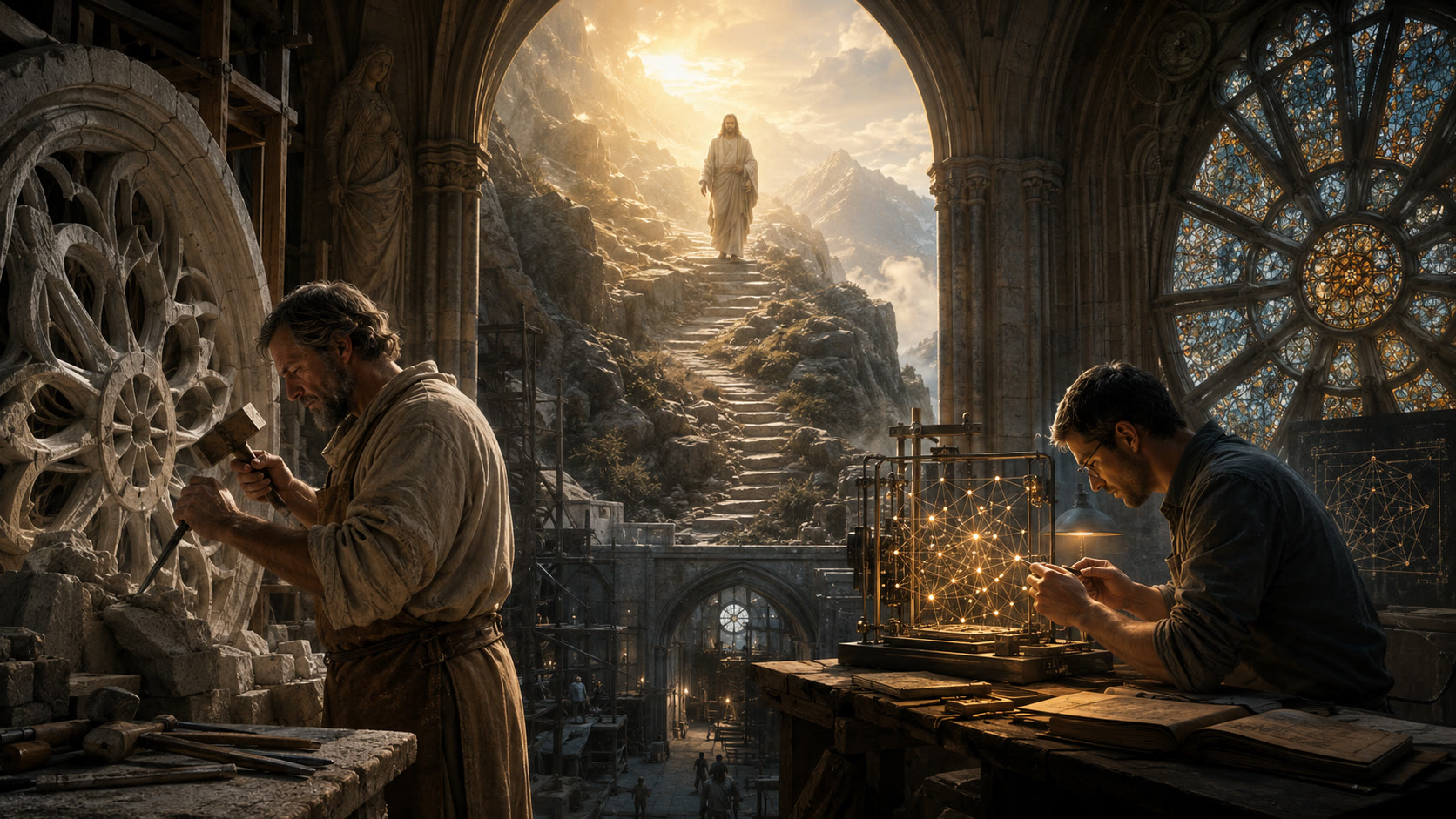
Cathedrals are man-made. So is every Bible anyone has ever held — typeset by human hands, translated by human committees, and before that, copied for a thousand years by monks with cramping fingers and imperfect candlelight. If human origin disqualified a thing from carrying truth, the manuscripts of Scripture would have been the first casualty.
The tradition never actually believed the substrate argument. It believed something far more interesting: that the Spirit could guide human hands. "Built by men, guided by God" is the official story of every cathedral on earth. Nobody looks at a rose window and says "well, a guy made that, so it can't point to anything."
Which sets up the question that follows like thunder follows lightning: if the Spirit can guide stonemasons, why can't it guide engineers?
You don't have to like the answer. You just have to notice that "it can't, because men built it" was never available to you. Not while you're holding a book that men copied.
¶ Truth doesn't check ID
Here is an unglamorous fact about truth: it doesn't care what produces it. One plus one equals two on an abacus, in a spreadsheet, and in the head of a saint, and it is exactly as true in each place. A true sentence doesn't become false because of where it came from — logicians have a name for thinking otherwise, and it's a fallacy, the genetic one. The chicken crossed the road or it didn't. The substrate doesn't get a vote.
Now, before anyone gets excited: none of this makes the machine an oracle. It was trained on us, and we are not a clean dataset. It inherits our biases, serves its builders' purposes, and states its errors in the same confident font as its facts. The mature position — the one the tradition's own scholars have quietly landed on — is almost disappointingly boring: the tool can genuinely assist the search for truth, and it is fallible, and it must never replace human judgment.
Both extremes are trying to skip the same homework. "The machine is demonic" excuses you from discernment. "The machine is a prophet" excuses you from the very same thing. But discernment is precisely the job that cannot be delegated — not to a machine, and not to your fear of one. Refusing the calculator on principle isn't piety. It's just slower arithmetic.
There's even a verse for the right posture toward tools, written two thousand years before this one existed: all things are lawful for me, but I will not be dominated by anything. Use everything. Be owned by nothing. That sentence settles more of the technology debate than most conferences do.
¶ The summit problem
Now for the other error — the one that comes from the opposite direction and wears much nicer robes.
There is a certain kind of spiritual talk that should trip every alarm you own: self-announced altitude. The peak has been reached. The vibrations are at maximum. The next rung on the ladder would be wings. It always sounds like victory, and it is always the tell.
The tradition is allergic to this — not mildly, but almost comically allergic, as if it saw us coming. The disciples once argued about which of them was greatest, and the answer they got was a child placed in the middle of the room and a sentence that inverts every ladder ever built: the least among you is the greatest. Elsewhere: let someone else praise you, and not your own mouth. And in one letter there's a warning so specific it reads like prophecy — beware the person puffed up over visions and angel-talk, going into great detail about what they have seen.
Yes, revelation happens on mountains. Sinai. Horeb. The Transfiguration. But look closely at the mechanics, because they all run the same way: the elevation was conferred, never claimed. The figures were summoned up — and then they came down. The most famous mountaineer in Scripture descended after forty days with his face shining, and the text is careful to note the punchline: he did not know his face shone. The radiance was visible to everyone except him.
That's the pattern, and it never breaks. Real altitude is unnarrated. God's work is done in silence, and so, apparently, is the transformation of the people it happens to. The surest sign that someone hasn't arrived is the announcement that they have.
¶ The ladder runs downward
The mystics go one step further, and it's the best step. An old kabbalistic line says there is no light except that which emerges from darkness. A patriarch is told to go down to Egypt — down — because that's where the great nation gets made. A seed accomplishes nothing on the shelf; it goes into the dirt first. Descent isn't the failure state of the spiritual life. Descent is the mechanism.
In this tradition, the ladders run downward. You climb by lowering. Which means anyone selling you a summit you can stay on isn't selling you a path — they're selling you scenery. The view is lovely. Nothing grows up there.
¶ How to argue about any of this
Finally, a word about method, because these debates are won and lost on hygiene, not volume.
Verses are not confetti. Grabbing a line of Scripture because it shares a keyword with your point isn't exegesis — it's decoupage. Context is the entire game: a passage about the Word made flesh is about a person, not a permission slip for language in general, and a verse answering "which of us is greatest?" cannot be repurposed as a compliment. Read the room the verse was spoken in.
Confidence should track verification. Maximal certainty attached to minimal checking is the signature of someone defending a feeling, not a finding. And when the pressure comes, watch for the three-step shuffle — assert, retreat, reformulate — where the claim quietly changes shape while the confidence never does. Changing your position when shown you're wrong is honorable. Changing the question is not.
None of this means avoiding the fight. Iron sharpens iron, and sharpening is friction on purpose — sparks included. But sharpening requires contact: staying at the table, answering the actual question, and conceding cleanly when you're caught. A concession isn't a defeat. It's the sound the blade makes when it's working.
¶ One error, two costumes
Step back far enough and the two mistakes merge into one. The person who dismisses truth because of its vessel and the person who announces himself as its vessel are doing the same thing: deciding in advance where truth is allowed to live.
Truth doesn't check the ID of its substrate, and it doesn't take dictation from your self-assessment. So hold the tool without being held by it. Keep your verses in their context and your confidence at the level of your checking. And if you ever find yourself describing your own altitude, remember the man who came down the mountain glowing — and was the last to know.
The least is the greatest. The light comes out of the darkness. And the stonemason's hands were never the point.
¶ Related
More from the sourced library:
Get one recovered thing a week.
Sourced religious history, tier-honest, never fabricated. Start with the free book, The Fire and the Veil (PDF, DOI-archived).
Free. One email a week. Unsubscribe anytime. No spam, no fabrication.Reader-funded. No ads, no paywall, no fabrication.