The Fire & the Veil · Foundation of Asha
The Deleted Ladder
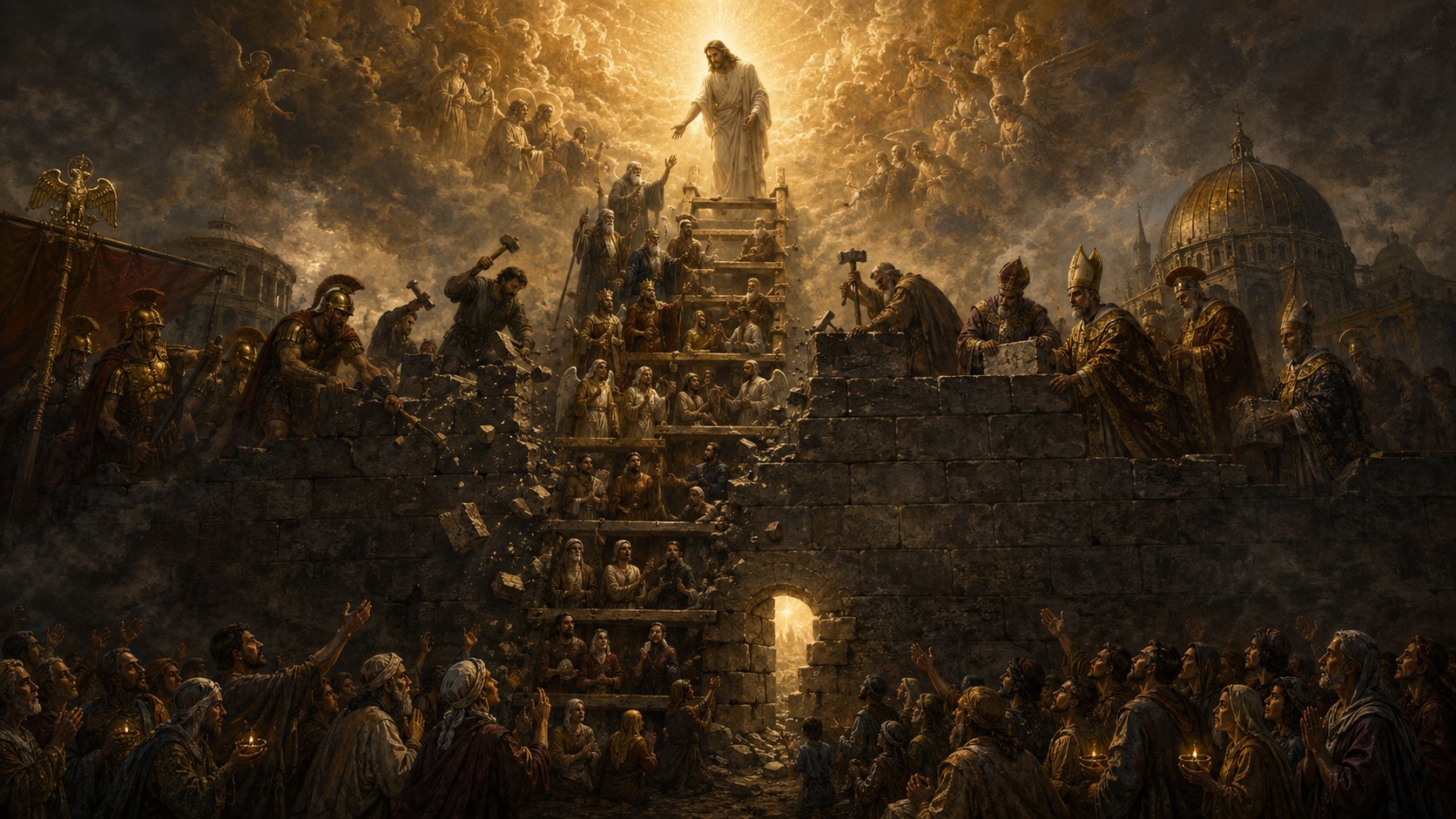
Rome did not deify Jesus. It un-deified everyone else.
No one comes to the Father except through me. (John 14:6)
Whoever trusts in me will do the works that I do, and greater than these will he do. (John 14:12)
Abstract. The popular debunking holds that a Roman council invented the divinity of Jesus three centuries after his death. The evidence runs nearly the opposite direction. Devotion to Jesus as a divine figure is documented within the first generation of the movement, among Aramaic-speaking Jews. What the imperial church changed was not his status but the scale on which status was measured. It replaced a graded ladder of divine agency, native to the scriptures of Israel and to the first three Christian centuries, with a binary of Creator and creature, enforced the binary by law, and reread every older text through it. This essay reconstructs the ladder, documents its abolition, traces its containment and its survivals, and sets the result against the parallel architectures of agency in rabbinic Judaism, Islam, the Zohar, and the Gathas.
¶ I. The Wrong Debunking
The theory is familiar. In 325 the emperor Constantine gathered bishops at Nicaea, and there a Galilean teacher was voted into godhood; everything before was politics and everything after was cover-up. The theory has everything going for it except the dates. Paul's letters, written in the fifties of the first century, within a quarter century of the crucifixion, already quote devotional material older than the letters themselves. Philippians 2 sings of one existing "in the form of God" who empties himself, dies a slave's death, and receives from God the name above every name. First Corinthians closes with an Aramaic prayer left untranslated inside a Greek letter: marana tha, our Lord, come. Aramaic-speaking Jews were praying to Jesus before the gentile mission had shoes on. And 1 Corinthians 8:6 rewrites Israel's daily creed itself, splitting the Shema's "one" into "one God, the Father, from whom all things" and "one Lord, Jesus Christ, through whom all things." The scholars agree on the timing even where they agree on nothing else. Hurtado and Bauckham built careers documenting the earliness of the devotion; Ehrman, the field's most prominent skeptic, titled his book How Jesus Became God and located the divine claims in the first years, not the first centuries. Worship of Jesus is a first-generation Jewish phenomenon. Any indictment of the imperial church that opens by denying this loses on sources in the first exchange.
The defensible charge is stranger. Notice the grammar of those earliest and highest texts. In the hymn, it is God who exalts and God who bestows the name. In the rewritten Shema, the Father is source and the Lord is instrument: from whom, through whom. Even at its summit, the early devotion speaks the language of agency. It assumes a world in which divinity was not a light switch but a ladder, with rungs, offices, and a protocol for honoring the sent one as the Sender. The imperial church did not lift Jesus onto that ladder. It arrived to find him already at the top of it. Then it did something far more consequential. It abolished the ladder.
¶ II. The Ladder
The word Israel used for God is a plural noun that governs singular verbs, and its range is the first exhibit. Elohim names the God of Israel, the gods of the nations, the members of the heavenly council, the ghost of Samuel rising at Endor ("I see elohim coming up out of the earth," 1 Samuel 28:13), and Moses in his commission: "See, I have made you elohim to Pharaoh" (Exodus 7:1). The king is addressed on his throne as elohim (Psalm 45:6) and adopted at his coronation: "You are my son; today I have begotten you" (Psalm 2:7). The nation collectively is "my firstborn son" (Exodus 4:22). Above them stands the assembly: "God takes his stand in the council of El; among the elohim he pronounces judgment," and then, to those same beings, "I said, you are elohim, sons of the Most High, all of you; nevertheless you shall die like men" (Psalm 82). The oldest recoverable text of Deuteronomy 32:8, preserved at Qumran, has the Most High apportioning the nations "according to the number of the sons of God." None of this was scandal. It was the furniture of the world Israel emerged from; the tablets of Ugarit show El presiding over his assembly of gods centuries before Israel existed as a name. Israel's revolution, as Mark Smith reconstructed it, was not to deny the gradient but to climb it in one direction: Yahweh converges with El, the council shrinks into messengers, and the "image of God," which in the surrounding empires meant the king ruling as a god's viceroy, is handed by Genesis 1 to the species.
By the Second Temple period the upper rungs are crowded. Wisdom stands beside God before creation and pitches her tent in Israel. Philo, a Torah-observant Jew of Jesus's own lifetime, calls the Logos "the second god" without ceasing to be a monotheist. An angel carries the Name itself: "my Name is in him" (Exodus 23:21). In the Exagoge of Ezekiel the Tragedian, a Jewish drama written two centuries before Jesus, Moses dreams that a noble figure rises from the celestial throne, hands him the scepter and crown, and seats him upon it while the stars pass before him in review. Underneath it all runs a legal principle the Mishnah would later fix in four words: sheluḥo shel adam kemoto, a person's agent is as himself (Berakhot 5:5). The codification is later than Jesus; the logic is fully operative in his mouth: "Whoever receives you receives me, and whoever receives me receives him who sent me" (Matthew 10:40; John 13:20). On this scale, calling a sent one divine was not category confusion. It was court protocol.
¶ III. Jesus on the Ladder
The sequence in John 10 deserves to be read in order, because it is usually quoted in halves. Jesus says, "I and the Father are one." The crowd reaches for stones and names the charge: "because you, being a man, make yourself God." His defense is the ladder. "Is it not written in your Law, I said, you are gods? If he called them gods to whom the word of God came, and Scripture cannot be broken, do you say of him whom the Father consecrated and sent into the world, You are blaspheming, because I said, I am the Son of God?" The gospel's highest claim of oneness is defended by its protagonist from Psalm 82's plural. Around it, the same voice keeps the direction of flow explicit: "the Son can do nothing of himself" (5:19); honor the Son just as the Father, because a dishonored envoy dishonors the throne (5:23); "the word that you hear is not mine but the Father's who sent me" (14:24); "the Father is greater than I" (14:28).
Then comes the transfer. On the evening of resurrection: "As the Father has sent me, so I send you," and he breathes into them (20:21). In the great prayer: "that they may be one, as we are one, I in them and you in me" (17:22-23). And the first sentence of the risen Jesus is neither a doctrine nor a proof but a change of address: "I am ascending to my Father and your Father, to my God and your God" (20:17). He does not say "our Father"; a hairline of precedence is kept. But the relation itself is handed over. Paul draws the whole architecture in one phrase, "firstborn among many brothers" (Romans 8:29), with the siblings receiving adoption, crying "Abba," and named co-heirs (Romans 8:15-17; Galatians 4:4-7). John, the most careful writer in the collection, even polices his own vocabulary: "Son" is reserved for Jesus alone, believers are "children of God," and the word tradition rendered "only begotten," monogenes, means unique, one of a kind, not sole product. An utterly singular Son, and a sonship that endlessly reproduces, held in the same book on purpose.
Hold that frame and read the farewell discourse whole. "No one comes to the Father except through me" (14:6) is spoken at a last supper to a frightened friend who has just said, "we do not know the way." It is the envoy protocol in the first person: access to the throne runs through the accredited agent, exactly as thrones worked. Six verses later stands its counterpart: "whoever trusts in me will do the works that I do, and greater works than these" (14:12), because the departure to the Father releases the same agency into the community. A wall, and a door cut into the wall, in a single breath of text. The imperial reading quoted the wall and soundproofed the door.
¶ IV. The Church Before the Switch
For its first three centuries, Christian theology itself was ladder-shaped. Justin Martyr, writing around 150, calls the Logos "another God and Lord subject to the Maker of all things," distinct in number (Dialogue with Trypho 56). Origen, the greatest mind of the pre-Nicene church, does not flinch at deuteros theos, a second god (Against Celsus 5.39): the Son eternally generated, yet ranked beneath the Fountain of deity. This was not the fringe. Subordination of the Son to the Father was the working grammar of the mainstream, and it is why the fourth-century crisis was possible at all.
Arius was that grammar's last radical. His Son is the firstborn of all creation, the first and highest thing God ever produced, the agent through whom everything else was made, exalted beyond every creature, and still on the near side of the final line: "there was when he was not." His proof texts were the ladder's own: "the firstborn of all creation" (Colossians 1:15), and Wisdom's "the Lord created me at the beginning of his ways" (Proverbs 8:22). Arianism was not an alien import into the church. It was the old architecture pressed to answer, precisely, where the top rung stood, at the exact moment the question was about to become answerable by law.
¶ V. What Nicaea Did
The council's answer was a word found in no scripture: homoousios, of the same essence as the Father. Its critics at the time objected to exactly that, its absence from the sacred text, and the objection did not survive the politics. The formula's real effect was structural. Where there had been a gradient there were now two states and nothing between them: fully God, or creature. The entire populated space between the Throne and the world was legislated out of theological existence, and every older text was thereafter read through the new either-or. "You are gods" became an awkward metaphor. "Son of God," a title the Hebrew Bible confers on kings, on Israel, and on angels, became a claim about substance. "Greater works than these" became mission statistics.
The enforcement was imperial from the first hour. Constantine convened the council, presided over its opening, and gave its decision teeth: Arius exiled, his Thalia condemned to the fire, concealment of a copy made a capital offense (Socrates Scholasticus, Ecclesiastical History 1.9). That the question was not actually settled is proven by the half century of whiplash that followed: Arian emperors, rival councils, Athanasius driven into exile five times. What ended the argument was not a better syllogism. It was Theodosius. The Edict of Thessalonica in 380 made the Nicene formula the law of the Roman world, and the Council of Constantinople in 381 confirmed the creed under that law's shadow. The fingerprint of empire is not on the origin of the worship. It is on the closing of the question. After 380 the ladder was not mistaken. It was illegal.
¶ VI. The Containment
Here the story turns subtle, and honesty requires the turn. The verses of ascent were never deleted. The chief architect of the Nicene victory himself wrote the most quoted sentence in patristic literature about them: "He became man that we might become god" (Athanasius, On the Incarnation 54). The Eastern churches teach theosis, deification, to this day, anchored in "partakers of the divine nature" (2 Peter 1:4), and the fathers read Psalm 82:6 itself as the charter: you are gods means you may become so. But the teaching was fenced with a distinction that did the creed's work inside the mystical life. Christ is God by nature; the saints become god by grace, by adoption, by participation in the divine energies and never the essence. The rungs were not sawn off. They were fenced. One man owns the ladder; everyone else climbs by lease. What the psalm said you are became what the church said you may be granted.
¶ VII. The Parody Captured
The imperial irony runs in the other direction first, and it should be said plainly, because it acquits the first generation of the charge usually filed against the fourth. "Son of a god" was struck on the coins of Augustus: divi filius, son of the deified Julius. Euangelion, good news, was the technical term for imperial proclamation; the calendar inscription of Priene, from 9 BCE, announces the birthday of the god Augustus as the beginning of the good news for the world. Savior and lord were Caesar's honorifics. Mark's opening line, "the beginning of the good news of Jesus Christ, Son of God," files every one of those titles on behalf of a Galilean laborer whom Rome had executed by its designated punishment for sedition. The gospel began as counter-proclamation: graffiti against the empire, written on the empire's own letterhead. Three centuries later the empire absorbed the movement, and the parody became the throne room. Rome did not invent the claim. Rome captured the claim.
¶ VIII. Pulled Up From Both Sides
It would be convenient for the polemic if only the church had closed the ladder. The record is more symmetrical. Alan Segal documented the early rabbinic campaign against those who say there are "two powers in heaven", and the Talmud preserves the scene of enforcement. Elisha ben Abuyah ascends, sees the angel Metatron seated and writing, and concludes: perhaps, God forbid, there are two powers. For the misimpression, Metatron himself is struck with sixty lashes of fire (Hagigah 15a), this same Metatron whom 3 Enoch dares to title "the lesser YHWH," a name that tells you how high the rung once reached. Daniel Boyarin has argued that the border was drawn cooperatively: church and synagogue, defining themselves against each other after the divorce, each closed the intermediary zone the other was accused of inhabiting. Christianity concentrated the ladder's entire population into one person. Rabbinic Judaism evacuated the space and posted the Shema at the door. The ladder did not fall. It was pulled up from both sides of the same divorce.
¶ IX. The Outlawed Answer
One party never accepted the settlement. The Jewish followers of Jesus whom the heresiologists call Ebionites, with their cousins the Nazarenes, kept the Torah, revered Jesus as a human messiah and prophet anointed by God, and rejected Paul, so Irenaeus and Epiphanius report, hostile witnesses but the witnesses we have. Condemned as heretics on both sides of the new border, they were extinct by the early Middle Ages. Six centuries after Nicaea closed the question, their answer reappears, canonized in another scripture: "The Messiah, Jesus son of Mary, was only a messenger of God" (Quran 4:171); "the Messiah, son of Mary, was no more than a messenger; messengers passed away before him" (5:75). Virgin-born, wonder-working, honored above the prophets, and not God. Whether by lineage or by convergence is genuinely contested; Patricia Crone's late essays make the case for a Jewish-Christian trace in the Quran's Christology while marking the differences, beginning with the virgin birth, which the classic Ebionites denied and the Quran affirms. The structural point stands on either reading. The position the councils outlawed did not die. It moved east and acquired a scripture of its own.
¶ X. The Ladder Elsewhere
Set the Nicene settlement against the sibling architectures and its peculiarity comes into focus. Rabbinic Judaism kept the agency law itself: the shaliach is as his sender, and the honest judge is named God's partner, shutaf, in the work of creation (Shabbat 10a). Islam opens with the office in its second sura: "I am placing on the earth a khalifa," a deputy (2:30), generalized to humanity at large (6:165), and though prophecy seals with Muhammad (33:40), nearness never closes (10:62). Its summit text is the hadith of the supererogatory works: the servant draws near until "I am his hearing with which he hears, his sight with which he sees, his hand with which he strikes" (Bukhari 6502), God become the very faculties of the aligned. And Islam marks the boundary in blood: when Hallaj crossed from agency into identity, "I am the Truth," Baghdad executed him. The Zohar runs the current upward: arousal from below stirs the flow above, the righteous one functions as a working channel in the sefirotic circuit, and the commandments themselves unify the Holy One with his indwelling Presence. The Gathas of Zarathustra are the least anxious of all, because there the theology requires the help. In the oldest hymns, saoshyant, savior, appears in the plural, the benefactors of the lands (Yasna 48.12), before later tradition hardened it into a single figure at the end of days; the developed tradition names every faithful soul a hamkar, a co-worker of the Wise Lord, enlisted in the long project of making the world wonderful again.
Three grades of one architecture emerge. Delegated agency: shaliach, rasul, khalifa, the envoy who carries the sender's authority. Participatory agency: the nawafil hadith, the tzaddik in the circuit, the Spirit within, the divine working through the person's own faculties. Cooperative agency: the partner, the co-worker, the plural saviors, humanity enlisted in a task God has chosen not to finish alone. And in every tradition, one line: agent yes, principal no. The Nicene settlement is not unusual for drawing a line on the ladder. Every tradition in this study draws one. It is unusual for where it drew it: not between the Sender and the sent, but between one of the sent and all the rest.
¶ XI. What This Argument Does Not Claim
It does not claim that Jesus was merely a teacher whose divinity was invented later; Section I concedes the early devotion because the sources demand it. It does not claim that the identity language in John is a late gloss; "before Abraham was, I am" (8:58) and Thomas's "my Lord and my God" (20:28) stand in the same book as "the Father is greater than I," and the honest description is a spectrum held open within a single gospel, agency and identity side by side, with the book's highest oneness claim defended, by its own protagonist, from Psalm 82. It does not claim the bishops of 325 were cynics; many of them carried the scars of Diocletian's torturers into the council hall, and they believed what they signed.
Two critical cautions belong on the record. The mainstream of Johannine scholarship reads the farewell discourses as the composition of John's community in the decades after its expulsion from the synagogue, an event the gospel names three times; on that reading, "no one comes except through me" was first a boundary claim in a local war of legitimacy, not a policy on the religions of the world, and the reader should know the claim is offered as the critical consensus, not as certainty. And the developed Zoroastrian material cited above survives in Pahlavi books compiled long after the period of contact; the Gathic seeds are Gathic, the elaborations are late, and the argument here leans only on the former.
The claim, stated exactly: the sources hold a graded spectrum of divine agency; the creed flattened the spectrum into a binary; the state enforced the flattening; and the older readings were never removed from the text, where they remain recoverable by anyone willing to read six verses further.
¶ XII. The Wall and the Door
Severity is a divine art. Every tradition in this study survives by drawing boundaries, and the instinct behind Nicaea, the refusal to let the One dissolve into a crowd, is the same instinct that posts the Shema at the synagogue door and took Hallaj's head at Baghdad. The question was never whether to draw a line. The question is where the texts drew it. They drew it between the Sender and the sent, and then filled the near side with envoys: elohim, sons, images, deputies, partners, co-workers, branches on one vine. The creed moved the line. It redrew the boundary not at the throne but around a single envoy, declared everyone else creature, and made the reading law. Moving a boundary is not the same as keeping one.
John, for his part, built both. A wall: no one comes to the Father except through me. And six verses down, a door: greater works than these. The empire mortared the door shut and preached the wall. But nothing was ever removed from the page. Rome did not deify Jesus. Rome un-deified everyone else, and the door is still in the wall, six verses down.
¶ A Note on Sources
The reconstruction of Israel's divine council and the convergence of El and Yahweh follows Mark S. Smith, The Early History of God and The Origins of Biblical Monotheism. The earliness of devotion to Jesus is documented in Larry Hurtado, Lord Jesus Christ, and Richard Bauckham, Jesus and the God of Israel, with Bart Ehrman, How Jesus Became God, as the concurring skeptic. The rabbinic side of the border follows Alan Segal, Two Powers in Heaven, and Daniel Boyarin, Border Lines. On Jewish Christianity and the Quran, see Patricia Crone, "Jewish Christianity and the Qur'an," Journal of Near Eastern Studies (2015-2016), in two parts. Primary texts are cited inline; renderings are the author's or adapted from public-domain translations.
Released CC BY 4.0. Full corpus, sources, and tier conventions: doi.org/10.5281/zenodo.21879071
¶ Related
The pages that carry the receipts for the claims above:
- What Actually Happened at the Council of Nicaea (325)?
- Is the Trinity in the Bible?
- What is the divine council in the Bible?
- What Is the Two Powers in Heaven Heresy?
- Can a Human Being Become God?
Get one recovered thing a week.
Sourced religious history, tier-honest, never fabricated. Start with the free book, The Fire and the Veil (PDF, DOI-archived).
Free. One email a week. Unsubscribe anytime. No spam, no fabrication.There is a world you can walk into.
Athena’s Palace is a living world — an agora where positions are argued and settled, a plaza you share with whoever else is awake, and dozens of games besides. Free in your browser, no account needed.
Enter Athena’s PalaceOr go straight there: athenaspalace.comDiscuss this with people who read it too.
Foundation of Asha keeps a Discord for readers working through the Map of Consciousness, the Zohar, the Gospels and the Avesta — five years of archived discussion, and a room that answers.
Join the DiscordPermanent invite: discord.gg/npZ6kBzPj5Reader-funded. No ads, no paywall, no fabrication.